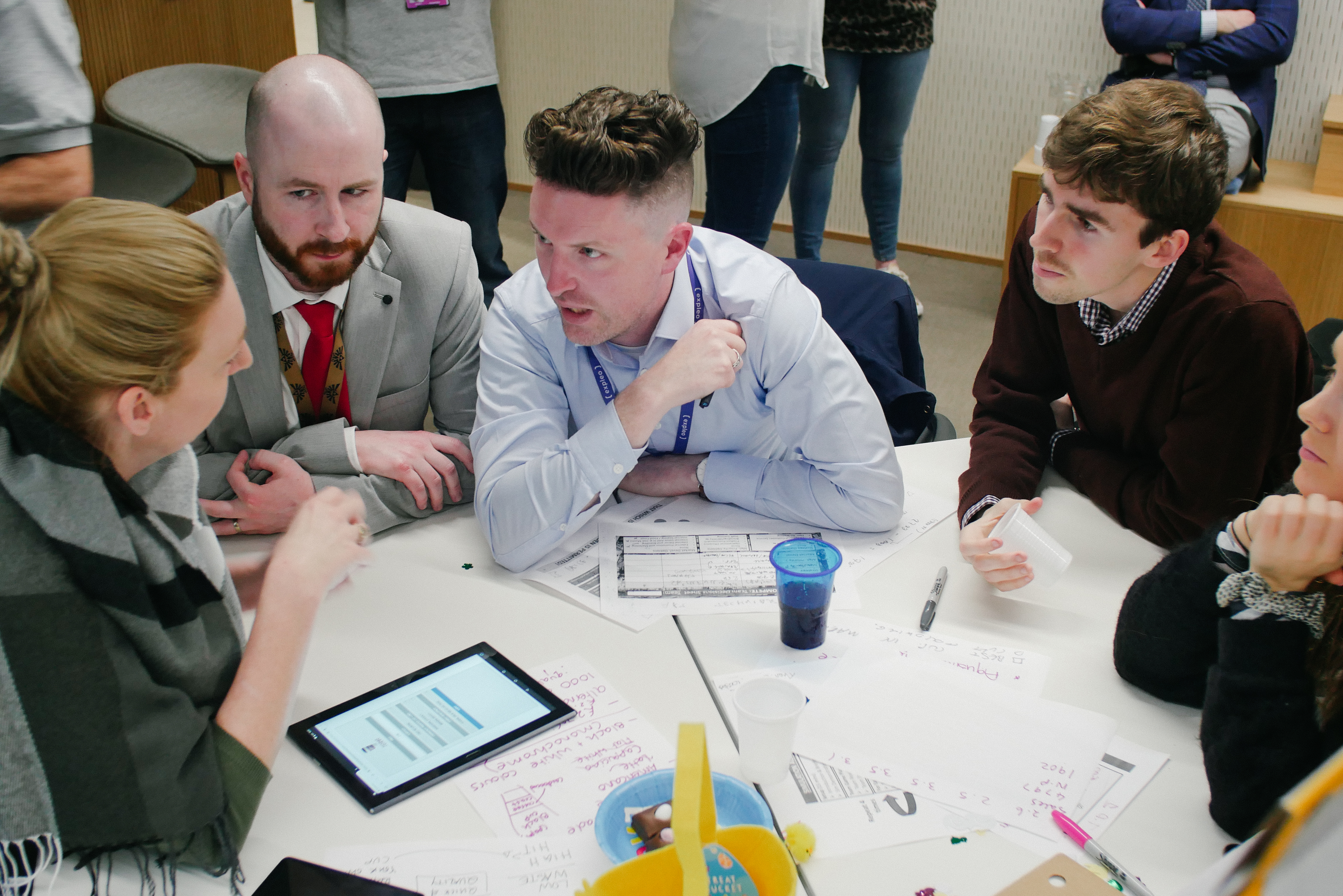
Team members engaged in discussion around a table during a business simulation exercise with documents and tablet.

Supply chain simulation

Flow

How can a supply chain management simulation help you?

Take charge of a live supply chain, commit to decisions on incomplete information, and discover how your team leads when there is no playbook.

How can a supply chain management simulation help you?

Take charge of a live supply chain, commit to decisions on incomplete information, and discover how your team leads when there is no playbook.

Flow is an immersive, facilitated simulation in which each team runs the supply chain of a manufacturing business, with your people in the room making every decision.

Participants will:

  • Act decisively on incomplete information, and judge when to move and when to wait
  • Experience how leadership emerges under pressure
  • Collaborate across functions when no single role owns the problem
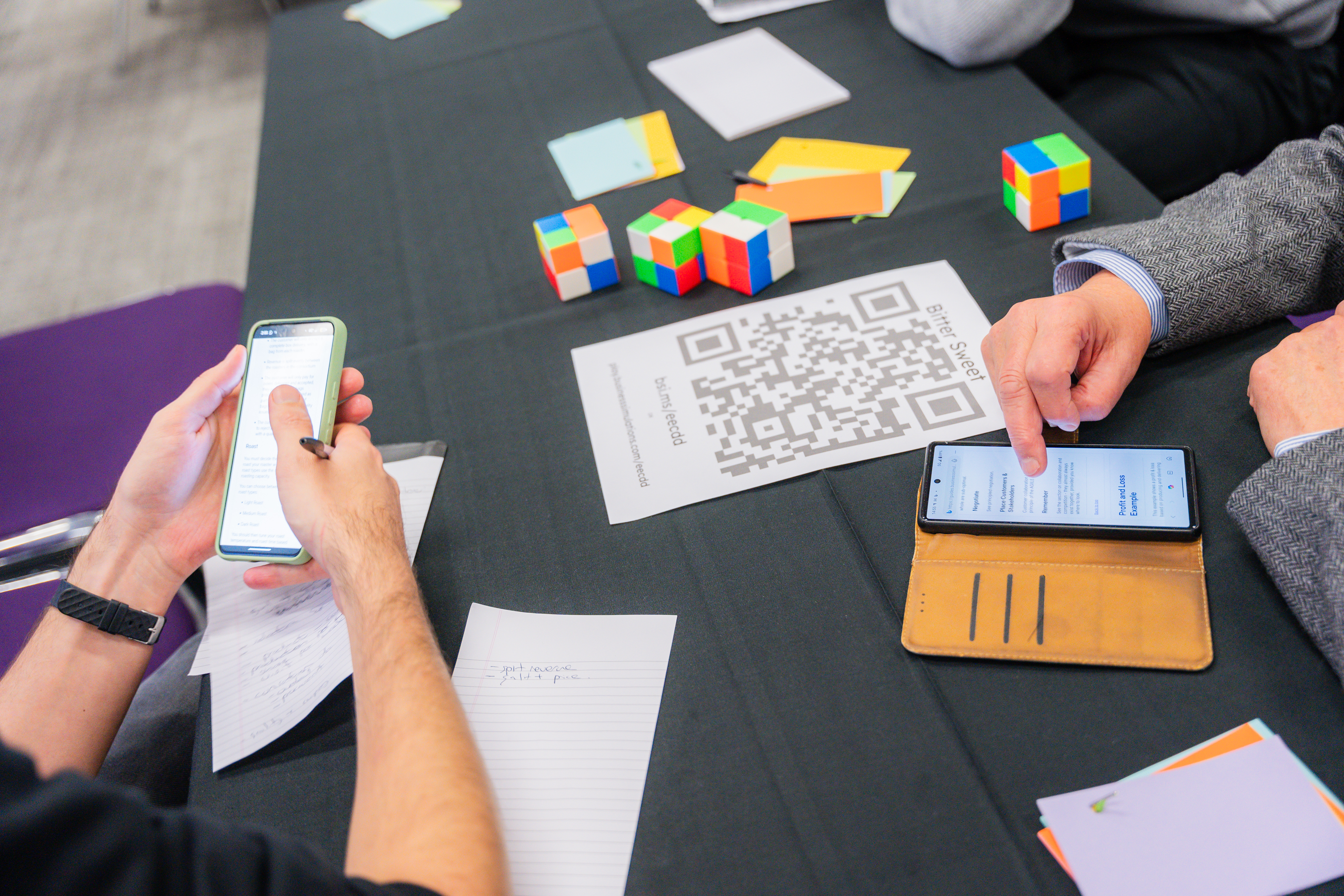
Team members using smartphones and analyzing puzzle cubes and QR codes on a dark table during a business simulation activity.

How Flow works

How Flow works

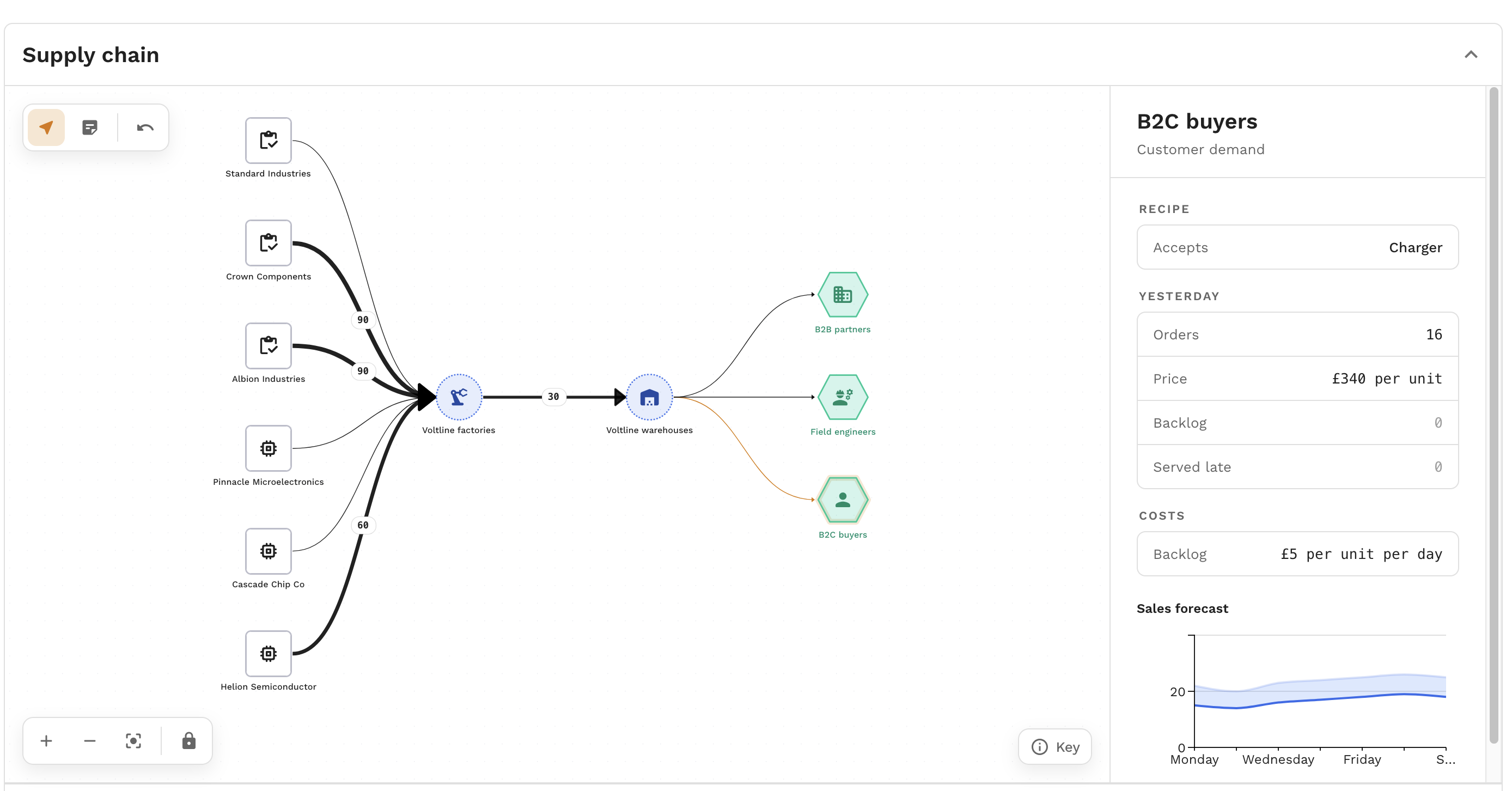
Participants step into the management team of a manufacturing business across four simulated weeks of trading. Teams run a live network of suppliers, factories, warehouses, and customers, adjusting orders and fulfilment each day while disruptions arrive along the way.

Each participant owns one of four manager roles, covering suppliers, production, customers, and finance, along with a set of performance metrics. Critical information arrives role by role, so no one person can see the whole picture. The industry, products, and disruptions can all be customised to mirror the pressures your teams face.

A supply chain diagram used in the Flow simulation

How Flow can help your business

Every order placed in Flow lands days later, which puts managers in a bind they will recognise: commit early and risk being wrong, or wait for certainty and pay for the delay. What that pressure exposes is judgement, and it develops capability across four dimensions.

Decision-making under uncertainty

  • Building a workable picture of an ambiguous situation
  • Judging when to act and when to gather more information
  • Managing the lead-time consequences of every choice

Leadership under pressure

  • Recognising the behaviours that unite a team rather than fragment it
  • Leading adaptively when there is no ready-made answer
  • Holding composure as events escalate

Cross-functional collaboration

  • Coordinating when the problem crosses every boundary
  • Surfacing what only you can see, before it matters
  • Aligning to a shared goal, not a single function

Operational governance

  • Holding the line on compliance and stock control under pressure
  • Resisting the small shortcuts that compound into failure
  • Balancing the drive to keep shipping with sound control

See how Flow would work for your team.

Who Flow is for

Flow suits any team whose work depends on keeping an operation moving when conditions change faster than the plan. It is most often used for:

  • Supply chain and operations teams, building judgement about lead times, stock, and trade-offs under disruption
  • Business continuity and operational resilience programmes, where people need to practise decisions rather than only read the plan
  • Cross-functional leadership groups, where no single function owns the problem
  • Management development programmes, using a live operational challenge to surface leadership behaviour
  • Conference and annual event sessions, needing an active centrepiece rather than a lecture

Flow in practice: British Telecom

British Telecom's supply chain team keeps around 23,000 engineers supplied every day. For its annual event for supply chain leaders, BT moved to Flow after a more complex simulation from another provider had left participants wrestling with the mechanics instead of the decisions.

The session was co-facilitated by BT's own supply chain managers alongside our team. The sponsor deliberately mixed roles, moving supplier managers away from supply management, to push people beyond their specialism. The room stayed active and competitive throughout, and participants connected what happened straight back to their real jobs.

Read the full British Telecom case study

This was a real step up from what we had run before. It was intuitive, easy to get into, and the ability to tailor it to our world made all the difference. Mixing up the roles pushed people out of their comfort zones and brought out the best in the team.

British Telecom logo
Allan LaneSenior Supply Chain Manager, British Telecom

At a glance

  • Duration: a two hour session, half day, or full day, depending on the depth you need
  • Format: live and in-person, facilitated by our experts on our collaborative, cross-platform technology
  • Scenario: teams run the supply chain of a manufacturing business across four simulated weeks, customisable to your industry and context
  • Skillsets: decision-making under uncertainty, leadership under pressure, cross-functional collaboration, operational governance

Talk to us about Flow

Tell us about your team and your programme, and we will show you how Flow would run for you. No obligation, and we will come back to you within one working day.