How leaders actually learn: creating their own story
By Tom ParsonsLast updated Aug 3, 2026
Leaders consume strategy content constantly and change behaviour rarely. They attend offsites, listen to keynote speakers, participate in fireside chats, and leave with the same mental models they arrived with. They may nod along, transferring information and sentiment, but missing any real learning outcomes.
The problem is not the quality of the content, nor the seniority of the speaker. It is the structure of the experience. Most executive education is designed around explanation rather than experience. It tells leaders what to think, but never forces them to act.
Real learning requires something different. It requires leaders to make decisions, experience consequences, and construct meaning from those consequences over time. In other words, it requires leaders to create their own story.
Not story as narrative or entertainment, but story as a sequence of choices, trade-offs, and irreversible outcomes. The kind of story you only get when someone is placed inside a system and allowed to shape it through their own actions.
This is why business simulations work when presentations do not. They do not deliver content. They create conditions in which leaders develop their own stories, and therefore their own learning. Experiential learning research consistently shows that active participation, rather than passive observation, is a prerequisite for meaningful and retained learning (Bransford, Brown, and Cocking 2000).
The simulation sets the groundwork for a story. The facilitator’s role is to make that story come to life, connecting participants’ decisions to real organisational dynamics and translating experience into insight.
Real-world vs fiction for simulation design
The choice between real-world and fictional scenarios is not purely aesthetic, it is pivotal in a business simulation for leaders to treat the experience as a legitimate method for learning, not just a game.
From a learning perspective, real-world business cases have three advantages: perceived realism, transfer fidelity, and credibility.
First, perceived realism. Leaders engage to a much higher level once they understand that the scenario they are faced with is truly representative of the critical decisions that they face in their own work, increasing psychological investment. (O’ Neill & Short, 2025)
This lends itself to effective learning transfer. Whereby the learning transfers naturally from the simulation, to their real-world applications in work. The real-world scenario provides the constraints leaders operate under; organisational politics, stakeholder management, incomplete information, and human behaviour.
Finally, by modelling our simulations with industry leaders, the real-world stories embody the credibility of the organisations they are based on. These scenarios have been dealt with, and the business has faced the consequences. This legitimacy matters when the goal is behavioural change, not simply conceptual understanding.
In simulation design and delivery, realism is not about copying reality in detail. It is about preserving the structural properties of reality: uncertainty, constraint, trade-offs, and irreversibility. Real-world stories already contain these properties. Fiction has to create them from scratch, and these often miss the mark.

Identification creates learning
Leaders learn when they stop observing, and start inhabiting the situation. The shift is from analysis to decision making, driven by experiential learning in a simulated environment.
When the ‘story’ is real, believable, and recognisable, the leaders identify with the work. They remove their real-world job title and step into the pressures, trade-offs, and ambiguity that only a simulated environment can provide. This plausible and recognisable experience leads to greater psychological engagement and cognitive immersion, leading to a greater depth of processing (Green and Brock, 2000).
This is where a simulation diverges from a simple case study. A case study looks backwards, with retrospective analysis. The outcome is known, the logic can be reconstructed, and the final narrative is decided. Whereas a business simulation denies hindsight and forces leaders to move forward, with incomplete information, and take accountability for their decisions. The story they create for themselves provides a depth of learning that truly sticks with the participants long after the programme is complete.
The art of storytelling in facilitation
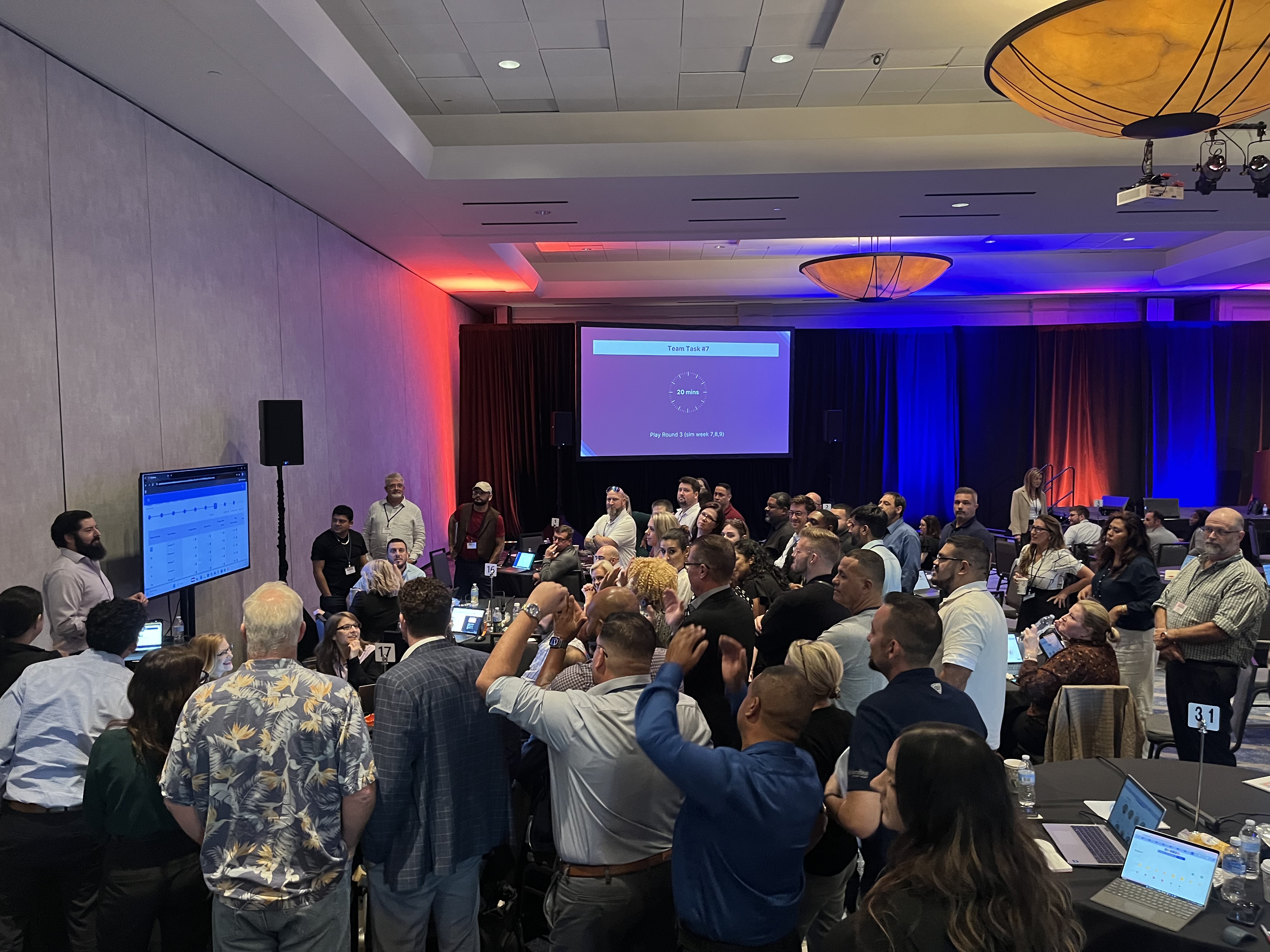
In a business simulation, the story exists in two forms. There is the real-world scenario that frames the experience, and there is the story created by participants through their decisions. The role of the facilitator is not to tell either story, but to surface the connection between them.
When facilitators narrate too early or explain too much, they overwrite ownership. When they intervene too little, experience remains unexamined. Effective facilitation sits between these extremes.
Each facilitator has their own style - I observe this through my train-the-trainer sessions and through the co-facilitation of our business simulations. However, every facilitator’s primary task is to connect the story of the simulation and the participants, to the real-world role of each leader taking part. The learning does not automatically emerge from experience alone.
The structured reflection, the tailored frameworks, and the anecdotal stories led by the facilitator are what connect the dots in the minds of the participants. The reconstruction of the narrative the facilitators have lived, observed, and taught through years of experience are what allows the individual to connect action to outcome, and abstract insights to concrete experience. Storytelling is the mechanism through which this reflection becomes coherent.
Crucially, effective facilitators must resist imposing a “correct” narrative. Instead, they help leaders articulate their own version of events, compare interpretations across the group, and create the psychologically safe accountability that is necessary for growth and learning.
When done well, facilitation transforms experience into insight without diminishing ownership. The story remains the participants’. The learning, therefore, remains theirs. This is the final step in turning simulation into sustained behavioural change.
Conclusion: Story as the mechanism of learning
Leaders do not learn through explanation alone. They learn when they are required to act, to commit, and to live with the consequences of their decisions. Story is the mechanism that makes this possible.
These elements form a simple but powerful learning system:
- Context grounded in real organisational dynamics
- Agency through decision-making under constraint
- Consequence that cannot be rewound or explained away
- Sense-making through structured facilitation
When these conditions are present, learning stops being theoretical.
This is the design philosophy behind Business Simulations. We do not teach leaders what to think. We design environments where leaders create their own stories, confront the implications of their choices, and leave with insights that transfer directly to their real-world roles.
References
O’Neill, G., & Short, A. (2025). Relevant, practical and connected to the real world: what higher education students say engages them in the curriculum. Irish Educational Studies, 44(1), 23–40. https://doi.org/10.1080/03323315.2023.2221663
Bransford, J.D., Brown, A.L. and Cocking, R.R. (2000) How people learn: Brain, mind, experience, and school. Washington, DC: National Academy Press.
Green, M.C. and Brock, T.C. (2000) ‘The role of transportation in the persuasiveness of public narratives’, Journal of Personality and Social Psychology, 79(5), pp. 701–721.
About the Author

A former professional poker player, Tom heads up our delivery team, ensuring our facilitators and clients have the support they need.
Published Jan 28, 2026