Fact or opinion? The one distinction that builds a safe team communications environment
By Ken ThompsonLast updated Sep 19, 2026
Ever been blindsided by something your team knew but never told you? If so, prepare to be surprised again, and not in a good way.
Great teams share a quality that is easy to name and hard to build: a SPACE, a safe, positive, authentic communications environment. It is a place where every member feels able to hold honest, and sometimes very difficult, conversations with their leader and with each other. It has to be positive and supportive, but also authentic and real, so that hard things can be said, and heard, with care.
This is not the general case for psychological safety; it is the one practical skill that builds it in everyday conversation: telling a fact from an opinion.
Facts are true or false. Opinions are useful or not useful.
A fact can be verified objectively by two independent witnesses. 'It rained in parts of Belfast today' is a fact. An opinion is a subjective judgement that two witnesses may disagree on. From the very same fact, I might offer the opinion that 'Northern Ireland is not a great place to live, because of the poor summers', while a local farmer says the opposite. Facts ground our opinions, but they do not turn them into facts. A grounded opinion is usually more useful than an ungrounded one, but neither is true or false.
So while a fact can be verifiably true or false, an opinion never can. An opinion can only be useful, or not useful, to the person hearing it.
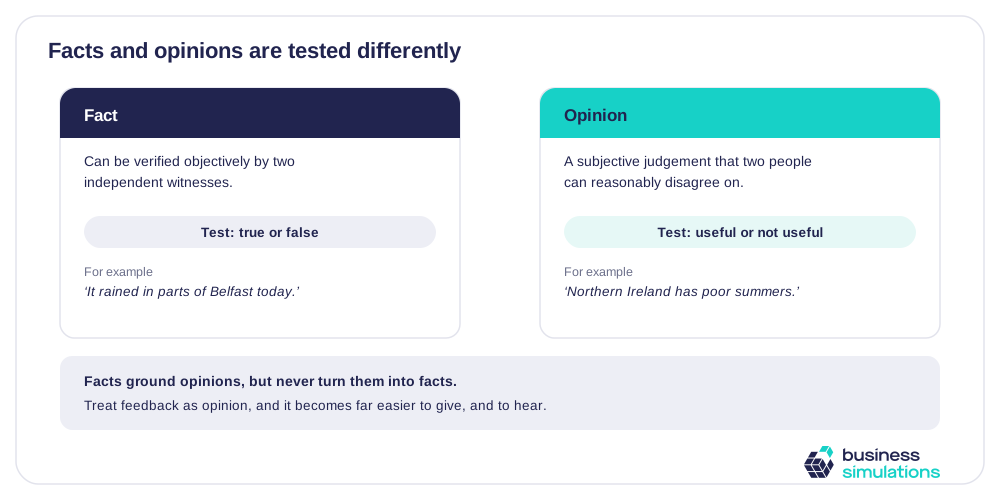
Why this matters for team communication
Miss this distinction and feedback curdles. If you tell me I could have done something better, and I hear it as a 'fact', I am likely to feel attacked, and to argue back to prove the 'fact' wrong. But if I understand it as an opinion, which can never be true or false, I can take it in without getting defensive.
The same is true when I am the one giving feedback. If I am careless about the distinction, I may push my opinion as the one correct way to see things. That makes my feedback almost impossible to hear, and useless to the person who might have acted on it.

It can all sound like common sense. But unless a team actively practises speaking and listening this way, the safe environment never forms, and the things that matter most to the team's success get left unsaid, or go unheard. A good team leader sets the example, openly inviting colleagues to challenge their opinions, one to one and as a group.
Does your team have a safe communications environment?
Five honest questions for any leader:
- Do I encourage my team to challenge me?
- When I am challenged, do I react well, and how do I actually know?
- Are my team members willing to challenge each other?
- Is there real evidence of them helping, and being helped by, one another?
- Do issues surface quickly, or fester until it is too late?
Build the SPACE before you need it
Teams that never invest in a safe communications environment leave themselves open to a steady stream of unwelcome surprises, and their leaders forever asking 'why am I always the last to know?'. The skills behind a SPACE, honest challenge, non-defensive listening, and the discipline to separate fact from opinion, are best learned by practising them under pressure, in a setting where it is safe to get it wrong.
That is what an immersive team simulation offers. Cohesion puts a team into a demanding shared challenge where trust, candour, and communication decide the outcome, so they build the habits of a safe communications environment together. It is one of the most direct routes to the kind of high-performing teams that say the hard things early, while there is still time to act.
If you would like to explore how a simulation could build this in your team, we would be glad to talk it through.
About the Author

Ken is an expert practitioner, author and speaker on collaboration, high-performing teams and game based learning.
Published Sep 11, 2018