How to mobilise a high-performing team using “Goals, Roles & Souls”
By Ken ThompsonLast updated Sep 14, 2026
L&D managers are often asked to put a focused, effective team together at short notice, for a new project, a departmental restructure or a facilitated learning programme, with little time to build the trust and clarity a team would normally take weeks to develop.
Goals, Roles & Souls (GRS) is a short, flexible checklist for doing exactly that. It turns a group of individuals into a working team in a single session, by making three things explicit before anyone starts: what the team is there to achieve, who does what, and how they will treat each other along the way.
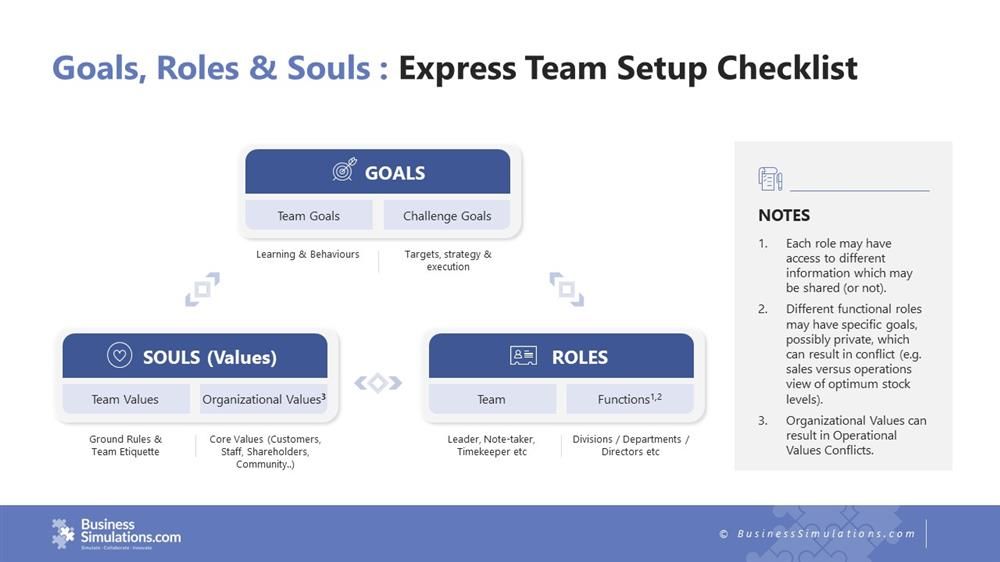
The three elements of Goals, Roles & Souls
A team is really a group of people (souls) working together (roles) toward a shared aim (goals). GRS makes each of the three explicit up front, rather than leaving them to be discovered the hard way once the team is already under pressure.
Goals: team goals and challenge goals
- Team goals cover the learning objectives or desired behaviours of the team
- Challenge goals cover the specific objectives the team has been formed to address: its target results, strategy and execution
Roles: team roles and functional roles
- Team roles are the divisions of labour needed for the team to operate effectively, such as leader, timekeeper and note-taker
- Functional roles are the divisions of labour needed to achieve the challenge objectives, such as CEO, sales director and finance director. Different functional roles may hold different information, or be given different, sometimes conflicting, goals, which is itself a useful source of tension in a learning scenario
Souls: team values and core values
- Team values address team etiquette and ground rules: how the team has agreed to deal with each other, and what will and will not be acceptable
- Core values represent the key values of the organisation the team is representing, which can themselves create useful values conflict in some team learning scenarios
Using GRS to mobilise a team quickly
GRS works because it forces a conversation most teams never have explicitly. Groups usually default to assuming goals, roles and values rather than agreeing them, and the assumptions rarely match. A short session working through all three, right at the start, gets a new team working well together far faster than leaving it to emerge naturally over the following weeks.
The checklist suits any situation where a group of people needs to perform as a team quickly: a business simulation or other group-development activity, a new project team, or a team assembled to respond to an urgent operational or strategic challenge.
Where GRS fits alongside team development
GRS is a useful starting checklist, but it is a single session, not a development programme. Building a genuinely high-performing team, one that still works this way under real pressure, takes practice in a live, challenging environment.
Our high-performing teams simulations put teams through exactly that: Cohesion builds trust and resolves conflict, Crew develops a team through a fast-paced project, and Cruise applies the same discipline to running a complex operation together, all facilitated by our experts and immersive enough that the lessons transfer directly back to work.
Get in touch to talk through which is the right fit for your team.
About the Author

Ken is an expert practitioner, author and speaker on collaboration, high-performing teams and game based learning.
Published Aug 23, 2021