The three levels of team performance management
By Ken ThompsonLast updated Sep 24, 2026
A team simulation gives managers and leaders something rare: hands-on experience of managing a team's performance under real pressure, building the psychological safety to be honest about how it is really going.
This is not the performance management of appraisal forms and annual reviews. It is something more useful: a team's own honest read of how likely it is to hit its goals, and the discipline to plan for what could go wrong.
When a team sits down to a simulation, the first thing they do is plan. Before the clock starts, they organise themselves for success: who does what, what could go wrong, and how confident they really are of hitting their goals. We ask them to rate that confidence at the start, again partway through, and once more at the end. Were they naively optimistic at the outset, then forced into some sharp mid-course corrections to scrape a result? Or did they know all along what it would take?
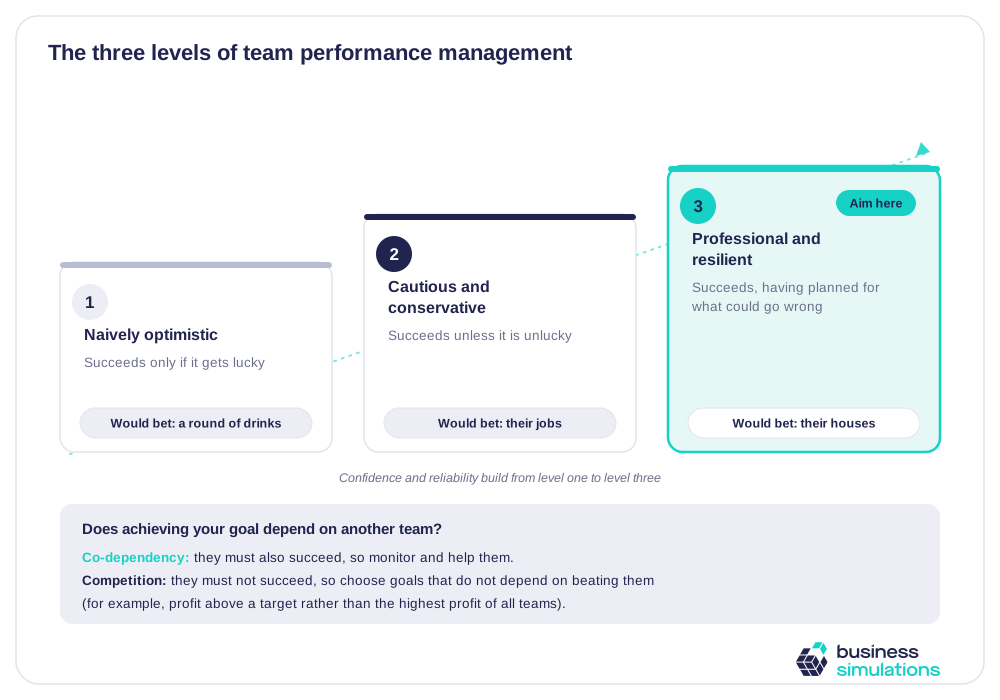
That simple habit, assessing confidence honestly, sits at the heart of performance management. Across many simulations we have watched teams operate at three distinct levels of it.
Level one: naively optimistic
The weakest level. The team will succeed only if it gets lucky. Picture a sales team that needs three wins, has six prospects, and converts one in three. They can get there, but only if the dice fall their way. Ask how much they would wager on success and they might, at a push, put up a round of drinks. There is no consistency here, and no real management of performance, just hope.
Level two: cautious and conservative
Stronger. The team will succeed unless it is unlucky. The same sales team now has 12 prospects for its three wins at the same conversion rate, so it comes up short only if things go against it. Teams at this level succeed most of the time, but they still stumble more often than their leaders would like. They might bet their jobs on the outcome, though that would be rash.
Level three: professional and resilient
The level to aim for. The team has thought through what could go wrong and built resilience into the plan to reduce and absorb the impact. This is not a guarantee of success, because nobody can promise that. An airline pilot cannot promise the plane will never crash, yet will happily stake their life on it not happening today. That is the standard organisational teams should hold themselves to: a consistency of result that colleagues and leaders can rely on, plan around, and yes, bet their houses on.
Must someone else lose for you to win?
The second question worth asking of any plan is whether hitting your goal depends on another team. There are two cases, and they call for very different behaviour.
Under co-dependency, you succeed only if another team also succeeds. Their performance is therefore your problem too, so monitor it and help where you can.
Under competition, you succeed only if another team does not. Here it is worth asking whether you truly need to beat them at all. Goals drive behaviour, so the goal you set matters. 'Make the highest profit of any team' is directly competitive and pins your success to someone else's failure. 'Make a profit above this level' is not, and frees the team to focus on its own performance. Often the second goal serves the business just as well, without the zero-sum fight.
Build the habit in your team
Performance management, in this sense, is not a form to fill in. It is a team's honest read of how likely it is to deliver, and the discipline to plan for what could go wrong. It is also a habit best learned by doing, rather than by being told.
That is what a team simulation is for. Crew puts a team through a fast-paced project where they must plan, commit to a goal, and manage their own performance as the pressure builds, then live with the results of how well they judged it, much as it did for more than 500 managers at a major UK bank.
If you want to build this discipline in your own teams, our high-performing teams programmes are built around exactly this kind of honest, pressure-tested practice. We would be glad to talk it through.
About the Author

Ken is an expert practitioner, author and speaker on collaboration, high-performing teams and game based learning.
Published Aug 7, 2018