Project management simulation training: five skills teams build
By Ken ThompsonLast updated Oct 20, 2026
'Operations keeps the lights on, strategy provides a light at the end of the tunnel, but project management is the train engine that moves the organisation forward.' Joy Gumz
If you run learning and development for people who deliver projects, you will know how hard these skills are to teach in a classroom. Today's projects are challenging, multi-stakeholder, and constantly changing, and a project manager needs to master five skills to succeed:
- Stakeholder management
- Change management
- Team management
- Work management
- Agile project management
This article explores each skill. It then explains how a project management simulation lets teams practise them, and how to choose one.
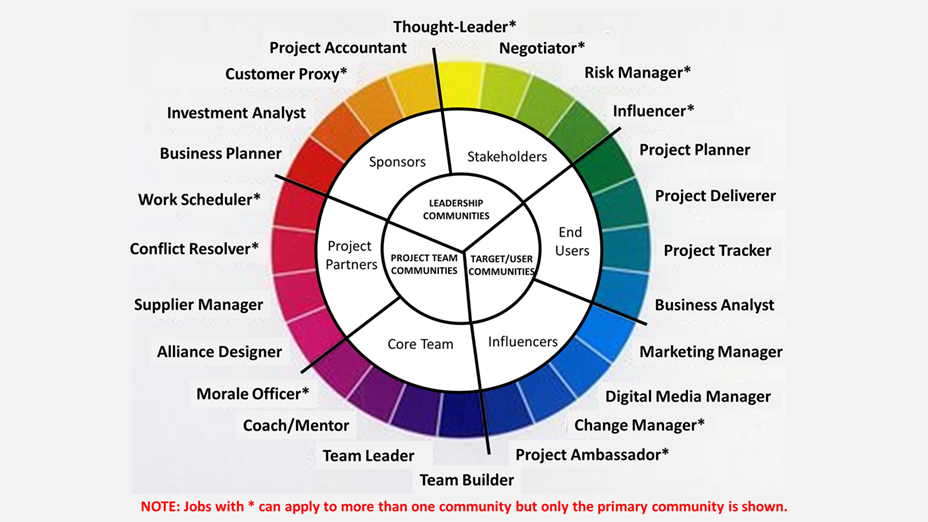
Stakeholder management
This is about managing all the different stakeholders a project needs in order to succeed. The UK Office of Government Commerce (OGC) defines stakeholders as 'individuals or organizations who are invested in a particular project and who are affected by this project in some way, and also their input has a direct impact on the project's upshot.'
In simpler terms, anyone who can impact or be impacted by your project is a potential stakeholder.
This is one of the factors that makes project management so difficult. You have to identify and manage the most important stakeholders, because there will be far too many to manage them all.
Change management
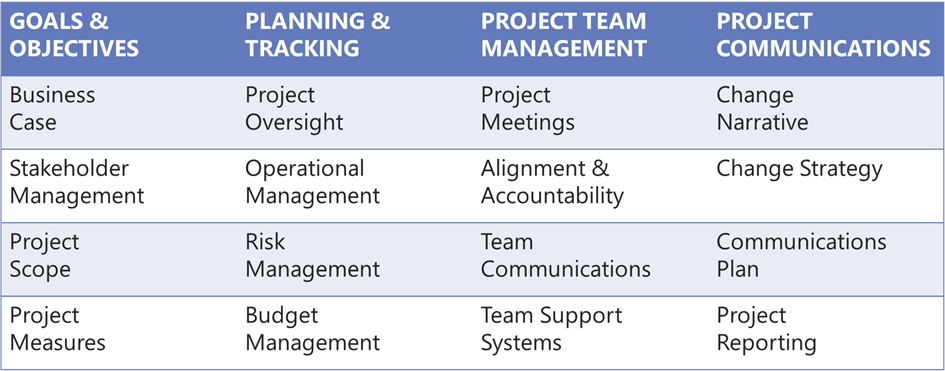
Change management means developing and executing a credible change plan, so that whatever the project is building, designing, or modifying is actually adopted.
Change management and project management go together like trains and tracks, or cars and drivers. Neither works without the other.
We might argue about the precise sequence and the preferred names, but a credible change plan needs to cover at least the following 16 aspects:
Team management
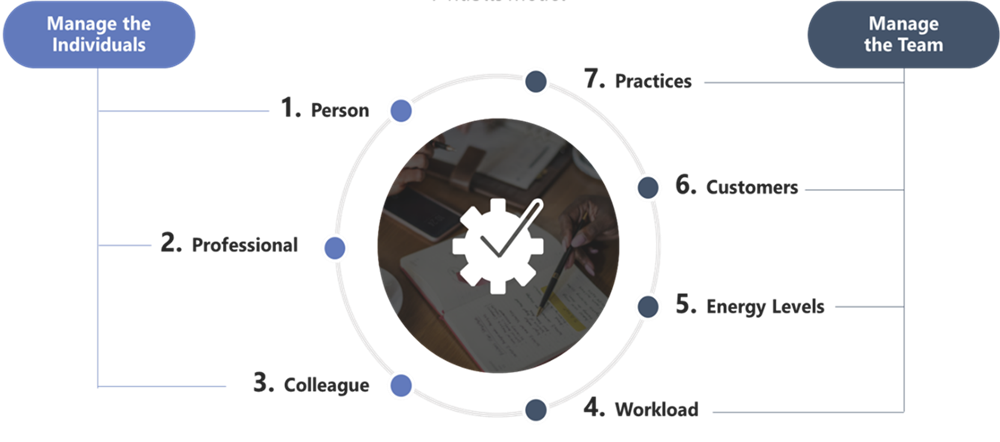
This is about looking after the project team, both as a whole and as individuals.
The diagram below summarises the key aspects of team and work management:
Work management
Work management means making sure the right people are allocated to the right task and are progressing it to schedule and to the customer's satisfaction.
With the right person on the right task, everything is possible. With the wrong person on the wrong task, nothing is.
Work should suit a person's skill level. Think Goldilocks: not too difficult or too easy, but just right. It should be difficult enough to stretch and develop them, and easy enough for them to succeed.
A good project manager also manages the intensity of the work, to keep colleagues safe from the twin perils of burnout and boredom.
Agile project management
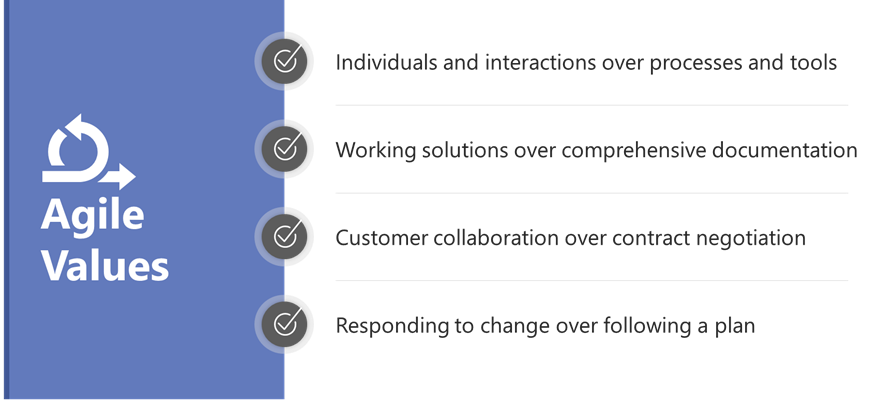
Finally, good project managers make sure the project is delivered in an agile, responsive way. How often have you been on the receiving end of 'project targets, deliverables, and outputs' instead of 'project outcomes, benefits, and transformations'?
Why use a project management simulation
Reading about these skills is the easy part. Using them under pressure, with competing priorities and real consequences for your decisions, is what separates a confident project manager from a hesitant one.
A facilitated business simulation gives teams that practice in an immersive, low-risk setting. Participants make decisions, see the results, and discuss what happened with an expert, so the learning lasts long after the session.
What to look for in a project management simulation
Whichever provider you consider, a few questions separate a useful simulation from an enjoyable afternoon:
- Does it let teams make decisions with consequences, rather than answer questions about project theory?
- Is it facilitated by experts who run a proper debrief, linking what happened to your own projects?
- Can it be delivered face-to-face, virtually, or as a hybrid, to suit a dispersed team?
- Can it be tailored to your own projects, terminology, and data if an off-the-shelf version will not fit?
Our project management simulations
We offer two complementary team-based business simulations that develop project management skills quickly, with an expert facilitator. Each lasts three hours, with a mid-point break, and is typically played by three to six teams of four to five participants.
Both can be delivered face-to-face, fully virtually, or as a hybrid of the two. They can also be played synchronously, with everyone playing at the same time, or asynchronously, with each team playing at a time of its choosing.
Crew
Focus: team and work management (skills three and four)
Summary: A team management simulation that develops team leadership and project scheduling skills. You allocate work to your team while managing constant people and team challenges, including staff capabilities, motivations, and other issues. Crew is the simulation to start with if your priority is a project team that delivers, and it sits within our high-performing teams challenge.
Influence
Focus: stakeholder and change management (skills one and two)
Summary: A change management simulation that develops influencing skills and an understanding of organisational and reputational power. You try to win the support of the key stakeholders essential to the success of your major change project. If adoption is your main concern, see our change management challenge.
Need something specific to your projects?
If your projects, industry, or terminology are specific to your business, a tailor-made simulation can recreate your own delivery challenges, so the practice is as close to the real thing as possible.
About the Author

Ken is an expert practitioner, author and speaker on collaboration, high-performing teams and game based learning.
Published Feb 25, 2021