Causation or correlation? Why knowing the difference makes you a better leader
By Ken ThompsonLast updated Jul 30, 2026
One of the most important leadership skills is knowing which levers to pull to make things happen. Put another way, it is the much-neglected art of understanding cause and effect in your organisation.
Get it right and you put effort where it counts. Get it wrong and you pour energy into things that never move the needle, or worse, set off problems you never saw coming.
For the want of a nail, the shoe was lost;
for the want of a shoe the horse was lost;
and for the want of a horse the rider was lost,
being overtaken and slain by the enemy,
all for the want of care about a horseshoe nail.
Benjamin Franklin
Franklin's proverb is a chain of cause and effect: one small, neglected cause, magnified link by link into a lost battle. Leadership is full of these chains, and of traps that keep us from seeing them clearly. Below are the four that most often catch leaders out, and how to build the judgement to avoid them.
Trap one: mistaking correlation for causation
The first challenge in understanding cause and effect is telling causation apart from correlation.
Here is a simple example. In hot weather, ice cream sales and suntan lotion sales both rise. Does that mean one causes the other? Of course not. Both depend on a common cause, the sunny weather. There is correlation, but no causation.
In your organisation it is surprisingly easy to make the same mistake: to see two things moving together and assume one drives the other, when the real cause lies somewhere else entirely. It is a costly error. Act on a false cause and you spend money and effort on a lever that was never connected to the outcome. A dashboard full of metrics that rise and fall together is a starting point for questions, not a set of proven answers.
But correlation is not the only thing to watch for. There are three more cause-and-effect traps that can catch you out.
Trap two: unintended consequences
When you change something, you do not always get the result you wanted. Sometimes you get an unanticipated result, or a side effect, that undermines or even reverses what you set out to achieve.

Take bonus schemes. A badly designed incentive can focus people on a short-term win at the expense of a much larger cost later. Think of the manager who shoehorns every possible sale into this year's numbers to hit a bonus, then leaves the cupboard bare for the new year, and for the poor colleague who inherits the patch after they are promoted.
These dynamics show up in almost any measurement or reporting scheme. It is one reason that managing through KPIs is harder than it looks: the moment you attach weight to a measure, people optimise for the measure, not always for the outcome you actually care about.
Trap three: time delays
A time delay is where the result of a change does not arrive immediately, but only after a lag. The temptation is either to strengthen the cause, over-adjusting, or to abandon it altogether and drift off course.
Time delays turn up in any supply chain, and the longer and more complex the chain, the more vulnerable it is. There is a classic management exercise called The Beer Game in which a slow supply chain leaves most players unable to get their stock levels right, forever swinging between far too much stock and none at all. The same delayed feedback shows up in product launches and large-scale change programmes, where the effect of today's decision may not be felt for weeks or months.
Trap four: implicit mental models
A mental model is your view of what causes what. We each hold two kinds, and they are often very different.
Your explicit mental model is what you believe you think, and what you would say if someone asked you. Your implicit mental model is what you actually do under pressure. The trouble with implicit models is that you often do not know you have them until it is too late.
The clearest example is a car skidding on ice.
- Explicit mental model: turn into the skid and recover
- Implicit mental model: fight the skid and lose control

The same gap opens up in business. Well-trained managers often react in a crisis in a completely different way from how they would calmly advise others to act. Instead of standing back and following what they know, they follow instinct, and make things far worse.
How to avoid the cause-and-effect traps
If you want to develop as a leader, reduce waste, get results that last, and avoid nasty surprises, you need to become a student of cause and effect. In practice that means four habits: tell causation from correlation, look for unintended side effects, expect time delays, and stay conscious of your own and your colleagues' invisible mental models.
One discipline helps more than any other. System dynamics, also known as systems thinking, gives you practical tools for causal analysis, so you can map the real causes and effects in a situation along with the side effects and delays that come with them.
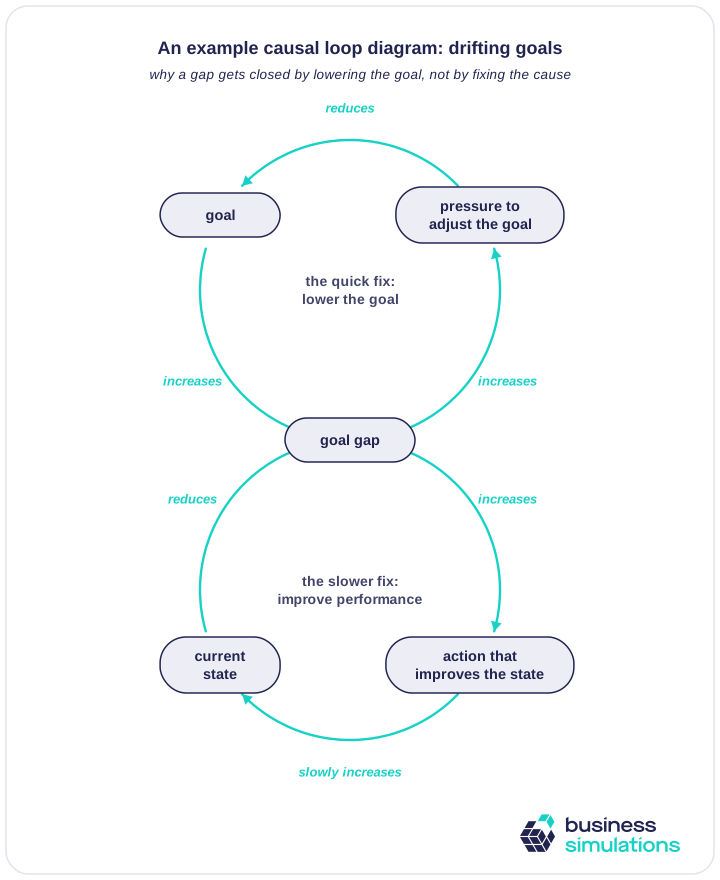
The 'drifting goals' pattern: a gap can be closed by real corrective action, which takes time, or by quietly lowering the goal, which does not. Under pressure, the second loop wins and standards drift.
Some lessons you have to experience
The tricky thing about cause and effect is that it is often counter-intuitive. You can read about it, but some lessons only land once you have lived through them. The problem is that if your team meets these shocks for the first time on the job, the damage is real.

This is exactly what an immersive, facilitated simulation is for. Our strategic thinking simulations let your team make decisions, feel the consequences, and learn from cause-and-effect shocks in a safe environment, with no cost to your career or your business. In Dilemma, for instance, teams work through a series of strategic, financial, and collaborative decisions and watch how today's choices ripple through the results. These are the same immersive, live and in-person simulations, facilitated by our experts, that we run for leadership teams at organisations such as Johnson & Johnson, Michelin, and PwC.
Further reading
- Unintended consequences and drifting goals, two of the classic systems thinking archetypes, explained by iseesystems
- Short-term fixes and the shifting the burden archetype
- Ken Thompson on poor mental models
About the Author

Ken is an expert practitioner, author and speaker on collaboration, high-performing teams and game based learning.
Published Aug 2, 2021