White paper: The Racetrack Model for high-performing teams
By Ken ThompsonLast updated Sep 17, 2026
Summary
A practical framework for L&D managers and team leaders who need a team's ways of working to actually stick, not just its kick-off day. The Racetrack Model treats building a high-performing team as two projects running side by side: change management and process development. It breaks team process into four areas and 16 specific practices, so you can audit where a team stands today and prioritise what to fix first.
Contents
- Process development for the team
- Team meetings
- Team alignment and accountability
- Team communications
- Team support and systems
- Two questions to answer before you start
- Grouping the processes by priority
- Putting the Racetrack Model into practice
Process development for the team
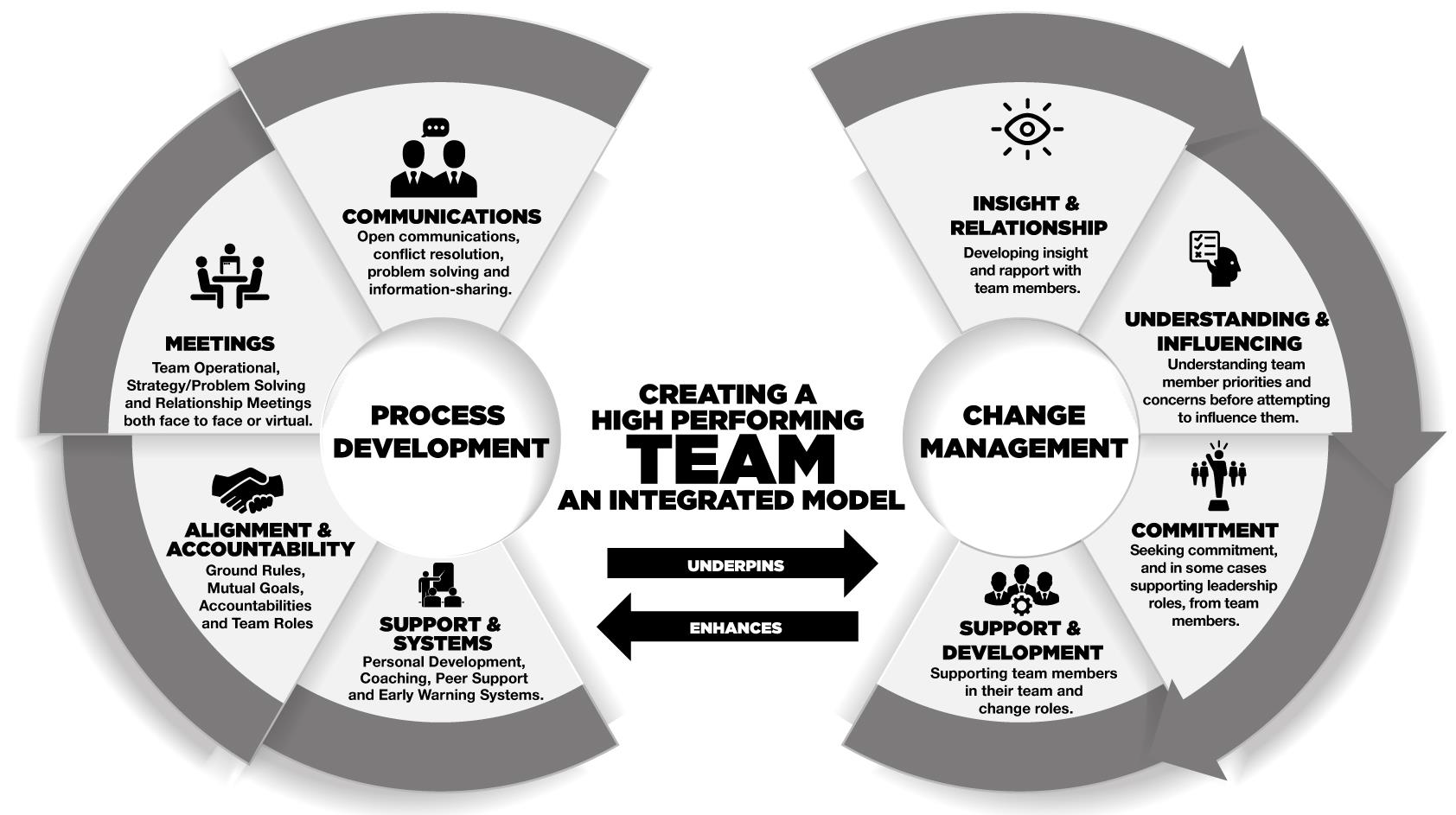
From research and practical experience, four areas of process are fundamental to a high-performing team:
- Meetings
- Alignment and accountability
- Communications
- Support and systems
These areas carry broadly equal weight: think of them as four legs of a stool. If any one is deficient, the stool becomes unstable and unfit for purpose.
Each area breaks down further into 16 specific processes and practices, four per area.
Team meetings
M1: Operational meetings
Make sure the team's operational meetings are regular and effective.
M2: Strategy and problem-solving meetings
Make sure the team's strategy and problem-solving meetings happen when needed and land well.
M3: Relationship and trust meetings
Make sure the team makes time, regularly, to build relationships and trust, not just to get through the agenda.
M4: Virtual and phone meeting practice
Make sure the team can run an effective meeting in person, remotely, or over the phone.
Team alignment and accountability
A1: Team ground rules
Define what counts as acceptable and unacceptable behaviour in the team.
A2: Team goals and objectives
Define and communicate the team's shared goals, and agree how you will communicate any change to them.
A3: Team member accountabilities
Give each team member clearly defined accountabilities within the team.
A4: Team leadership roles
Build supporting leadership roles into the team, not just a single team leader.
Team communications
C1: Open communication
Give team members an environment where they can be open with the team leader and with each other.
C2: Conflict resolution
Equip the team with a process to resolve interpersonal conflict quickly and constructively.
C3: Decision-making
Use recognised decision-making techniques suited to the situation in front of you.
C4: Information-sharing
Share accountabilities, priorities, updates, and information effectively across the team.
Team support and systems
S1: Personal development
Put personal development in place for every team member.
S2: Coaching relationships
Keep team leaders in regular coaching conversations with the people they lead.
S3: Peer support
Get team members supporting and helping each other directly, rather than routing everything through the leader.
S4: Early warning systems
Ask team members to look out for risks that could affect a colleague's ability to deliver.
Two questions to answer before you start
Before implementing these 16 processes, answer two questions: which processes matter most for your team, and are the priorities the same for every team?
Taking the second question first: no. Every team starts from a different place, so your first task as a team leader or team builder is a process health check against this framework. For each of the 16 processes, establish whether it exists at all, how far it is embedded, and how well it is working.
Once you have that picture, prioritise the processes that are absent or broken over the ones already working to some degree. That is not the whole story, though: some processes matter more than others. A broken operational meeting damages the team every week; a broken relationship meeting might only cost you once a quarter.
Grouping the processes by priority
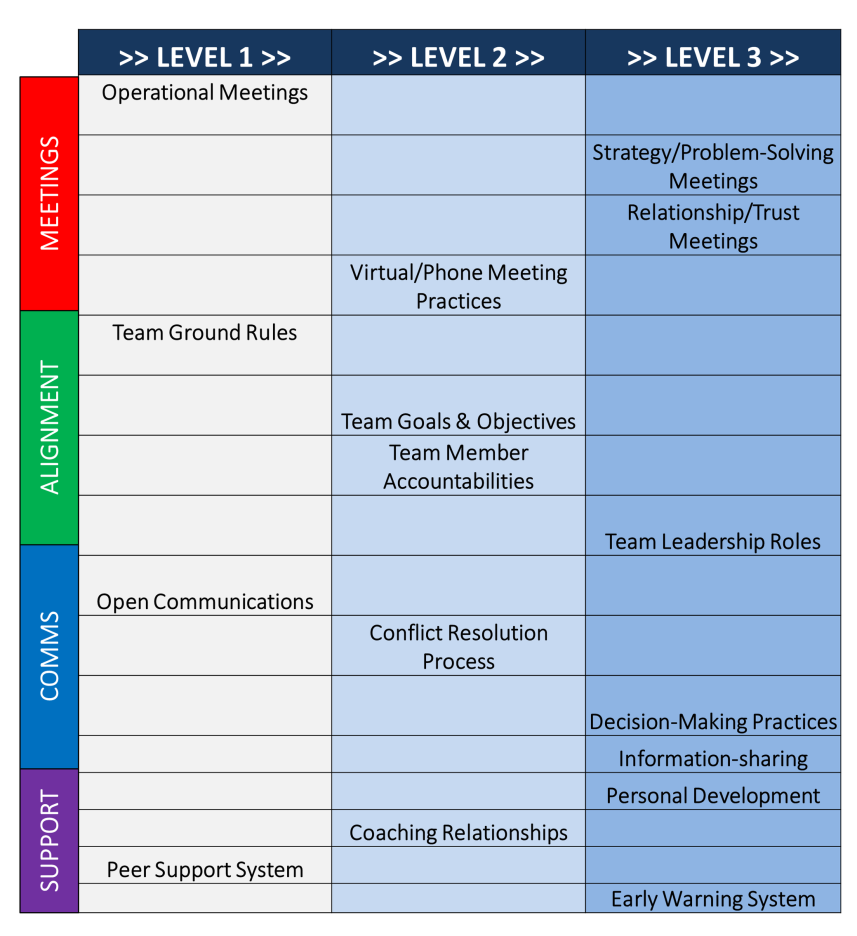
Group the 16 processes into three levels of maturity, and work through them in order rather than all at once.
Level 3: Advanced processes (seven)
Level 2: Key processes (five)
Level 1: Foundation processes (four)
Working level by level builds 'basecamps' of process maturity as the team climbs, and avoids the improvement chaos that comes from trying to fix everything at once.
Figure A sets out a practical sequence for improving the 16 processes. It is a guide rather than a strict prescription: all else being equal, the four processes worth fixing first are operational meetings, ground rules, open communication, and peer support.
Putting the Racetrack Model into practice
Start with a process health check, then use relative importance to build a development plan that fits your team and reflects what good practice looks like elsewhere.
Running that health check, and practising the fix, works best under real conditions rather than on a whiteboard. Cohesion puts a team through the trust-building and conflict-resolution work behind this framework's communications area, and Crew does the same for the accountability and personal-development work in support and systems. Both sit within our high-performing teams programme.
About the Author

Ken is an expert practitioner, author and speaker on collaboration, high-performing teams and game based learning.
Published May 30, 2025