Seven tools for designing your own business simulations
By Ken ThompsonLast updated Oct 11, 2026
This guide is for learning and development managers who need a custom simulation but have limited time and budget. It explains seven business simulation engine design metaphors, how to choose between them, and when a tailor-made simulation is the better route.
Imagine the scenario
'To meet your organisation's unique needs to enhance skill development in your leadership and manager community, it has been determined that a custom business simulation is required. The problem is such a simulation needs to be ready to use in eight to 12 weeks, and you have a limited budget. On the plus side, you have some excellent internal people available with great knowledge of the business and strong content development skills. You have a dilemma: you need a custom simulation but you just do not have the time or the budget to build one.'
The business simulation engine option
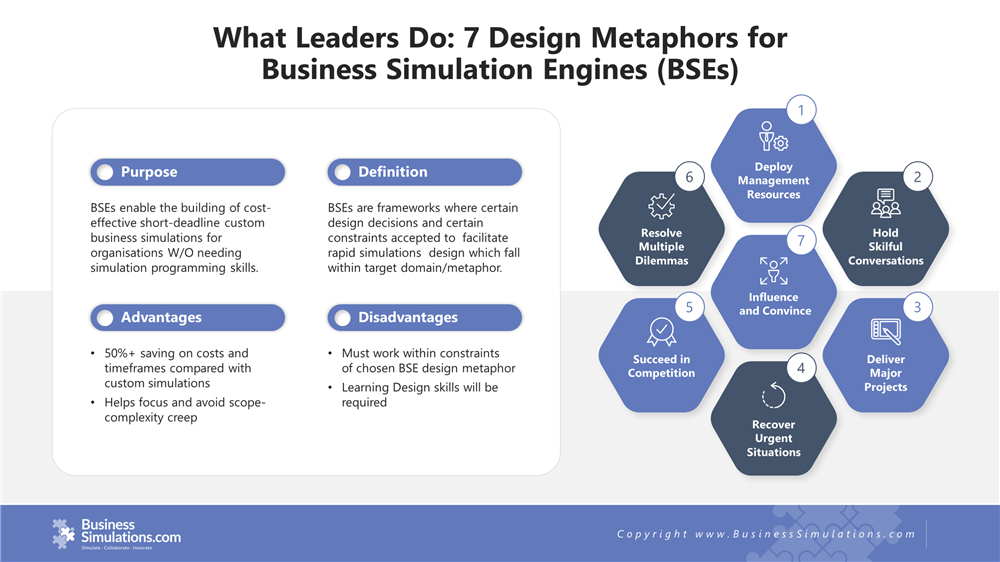
A solution to that dilemma could be a business simulation engine (BSE). Our infographic, 'What leaders do: seven design metaphors for business simulation engines', summarises what you need to know.
Seven design metaphors
Each business simulation engine takes a key aspect of what leaders do in organisations and focuses on enabling a designer to model that aspect comprehensively in a design-friendly way. It is not feasible to have a general-purpose simulation engine usable by non-programmers. Instead, BSEs are simulation frameworks where specific design decisions and constraints have been made to enable rapid development of simulations within a defined domain or metaphor.
Let us explore each of these metaphors in more detail.
Metaphor one: deploy management resources
In this metaphor, the designer models the organisation as a system in which the top team must optimise how it allocates limited time and governance across competing areas to achieve the best results.
Metaphor two: hold skilful conversations
This simulation facilitates key conversations between the computer and the player (team or individual) in the form of role plays. The computer's responses and knowledge are codified by the designer using a state transition model, and the player's conversational moves are scored accordingly.
Metaphor three: deliver major projects
Players must deliver a major project or programme, which can be fully defined and configured by the designer.
Metaphor four: situational judgement
The designer constructs an ongoing scenario using simple PowerPoint slides, for example a crisis. As the scenario is revealed to the players slide by slide, they answer multiple-choice questions about how they would address the situation. Results are displayed instantly on a dashboard of key measures, with a leaderboard and graphical analysis of the choices.
Our Breach simulation applies this kind of judgement to a cyber incident, and Innovate applies it to innovation strategy.
Metaphor five: succeed in competition
This metaphor models the organisation as an entity competing in real time with others for market share. The designer can specify the industry, market size, and financial and market conditions for each round. See Compete for a ready-made example.
Metaphor six: resolve multiple dilemmas
An extension of the previous metaphor, this format allows the designer to create a developing backstory that presents four dilemmas to players each round. Their responses impact the organisation's reputation, health, and commercial performance. Dilemma is our ready-made version.
Metaphor seven: influence and convince
This metaphor is appropriate for major organisational projects and programmes, focusing on how support can be won from key stakeholders. The designer can configure each stakeholder's power, influence, relationships, and attitudes. Influence shows how this works in a nine-week change initiative.
Choosing your business simulation engine
Begin by defining the key activities or learning objectives your simulation must address.
Next, identify the BSEs that align with those goals. If you find that your needs span multiple BSEs, it may be a sign that the scope is too broad. Narrow your focus to what is essential.
Finally, follow an incremental design, build, and test approach. Develop an initial version, test it with target users, and refine it based on their feedback. Avoid attempting to solve everything at once.
By following these three steps carefully, you can design a valuable, custom business simulation quickly and cost-effectively, one that your organisation can benefit from for years to come.
Build in-house or commission a simulation?
An engine suits you when the learning objective fits one metaphor, you have people who know the business well, and you can test with real users. It is a poorer fit when your need is specific to your own industry, products, data, or terminology.
Ask yourself three questions before you start:
- Does an existing simulation already cover the skill? Our strategic thinking and change management challenge pages show which ready-made simulations map to which capabilities
- Does the scenario need your own numbers, language, and decisions to be credible to participants?
- Can your team commit to several rounds of design and testing?
If the answers point towards a need that only your organisation has, a tailor-made simulation lets our team do the build, drawing on work we have delivered for clients such as Allied Mills, Twinings, SPAR, and Associated British Foods.
About the Author

Ken is an expert practitioner, author and speaker on collaboration, high-performing teams and game based learning.
Published Aug 31, 2020