Developing custom business simulations
By Ken ThompsonLast updated Oct 14, 2026
This article is for learning and development managers weighing up a custom business simulation: what building one involves, how long it takes, and when a shorter route makes more sense.
We offer a portfolio of business simulations 'off the shelf' that cover a wide range of leadership and management topics. Sometimes, though, a client needs something specific to their own business. That is where a custom business simulation comes in, and it is what the rest of this article explains.
Why customise a business simulation?
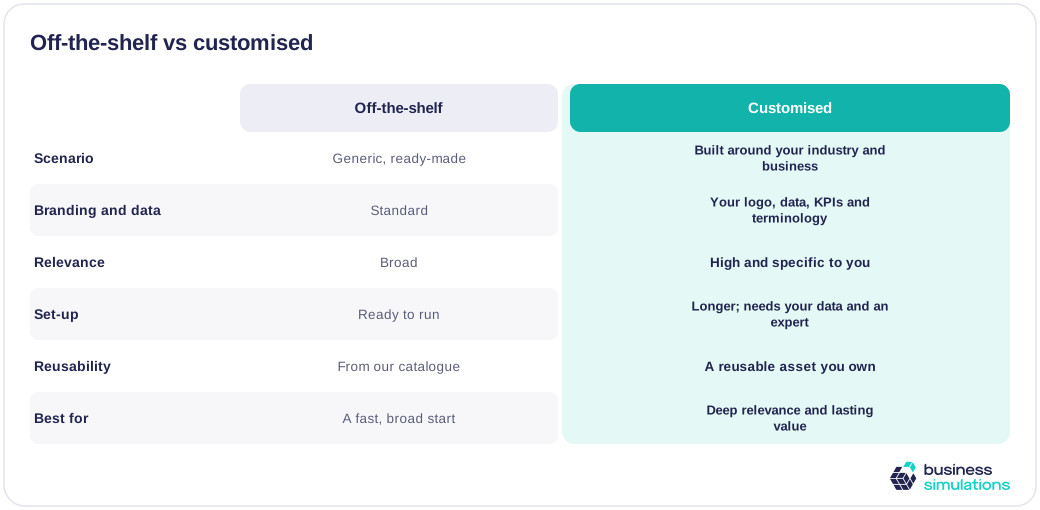
A tailored simulation tends to land better than an off-the-shelf one, for a few reasons:
- Using a company's own products, data, and language makes the simulation feel real rather than generic, so participants recognise the world they are in and carry the lessons straight back to the day job
- A tailored simulation becomes a lasting, reusable asset that the organisation owns and can run again as needs change
- Company-specific events are more memorable than generic ones: a supermarket manager will remember how their team handled a scenario about their own out-of-date stock far more vividly than an unrelated example from another industry
Sharper relevance, a reusable asset, and lasting learning are what make the extra design time worth it for many organisations. If you need a faster or lighter start, an off-the-shelf simulation, or a foundation simulation built on top of an existing engine, can get you most of the way for less. If an existing simulation already covers your topic, check it first: Dilemma and Acuity cover strategy and finance, for example.
How long does a custom simulation take?
Building a business simulation from scratch is a sizeable undertaking, though new tooling has brought the timescale down sharply: a custom simulation now usually takes around six to 12 weeks to complete.
Our eight-step build process
Our development technique follows an eight-step process from scope to delivery.
- Scope: What are the key learning objectives that the simulation must address? At this first stage, our learning, development, and design team will be involved
- Programme design: How should the simulation be delivered and packaged? The simulation is a learning tool that should be used as part of a wider programme of learning. Our learning team works closely with the client's L&D department to ensure the simulation and the programme it supports fit together
- Business logic design: What are the inputs and outputs that drive this simulation, and what effect should they have? Our development team will write logic unique to each custom simulation
- Presentation design: How should the simulation be presented to the users? Our design team will sit down with the client and compose a user interface (UI) that gathers inputs and presents outputs in an intuitive manner
- Document design: A big part of our learning methodology involves digesting and responding to information from supporting documentation. A credible set of documents making up the backstory and news updates will make the simulation experience more immersive, but takes time and skill to author. Our learning and design team will work together to provide engaging and well-presented custom documentation
- Testing: An often underrated part of any design and development project. We know from experience that it is very unlikely the first iteration of the simulation will be the final one. Through user testing and pilot sessions, the simulation will be put through its paces and benchmarked against the learning objectives defined in the scope
- Design iteration: Programme, business logic, presentation, and document design will be refined and retested
- Training: Typically, with a made-to-measure business simulation, the client will want their L&D team to deliver the simulation. Our learning team will provide 'train the trainer' (TTT) sessions so that the delivery can be handed over to the client's in-house team
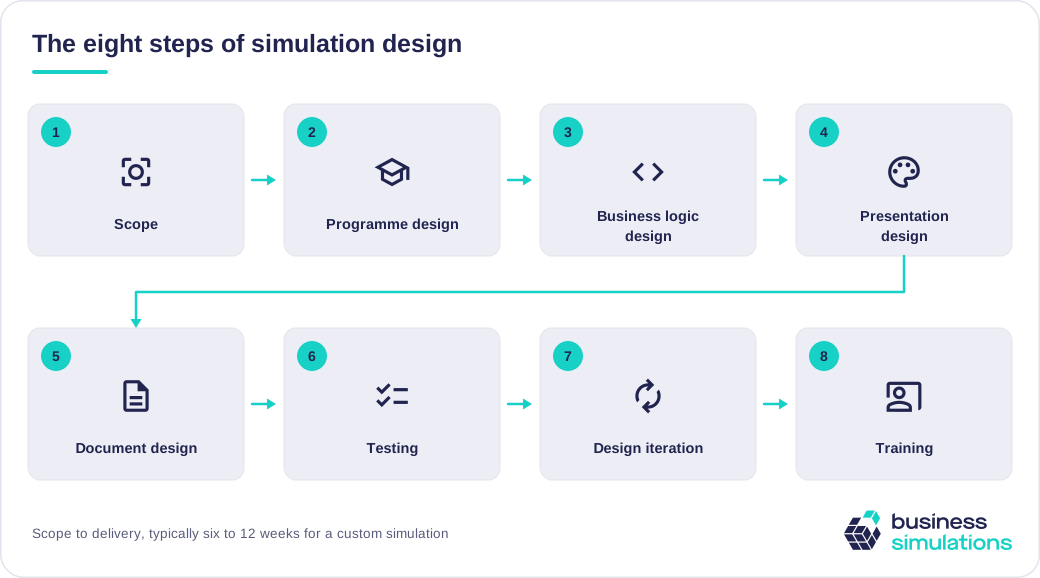
Six to 12 weeks is a short run for a simulation built from scratch, and as you can see, the process behind it is intensive. There are no shortcuts if you want to deliver an immersive learning experience that challenges and engages the leaders within your organisation, so the time saved comes from better tooling rather than from skipping steps.
Foundation simulations
If you are looking for a shorter time to market, and a less costly approach, there is another option: building a custom simulation on top of our foundation simulation. Our foundation simulation, supporting business strategy, is Dilemma.
A foundation simulation is a starting point that accelerates the custom simulation development process by allowing our clients to take advantage of predefined generalised logic and functionality designed with a certain leadership topic in mind, for example business strategy.
While a foundation simulation offers less flexibility in terms of custom logic and presentation, this hybrid approach still provides plenty of options to create a completely unique simulation in a fraction of the time.
Custom simulations in practice
Seeing how other organisations have approached a custom build is often the quickest way to judge whether it is right for you:
- Twinings brewed up a custom team-based learning simulation
- SPAR created a custom solution for its convenience stores
- Allied Mills built strategy skills with a simulation based on its own business
- BT used a tailored supply chain simulation to sharpen cross-functional working
If your need is specific to your own business, industry, or data, our tailor-made simulation service is the place to start. You can also contact us to talk through whether a custom build or a foundation simulation fits better.
About the Author

Ken is an expert practitioner, author and speaker on collaboration, high-performing teams and game based learning.
Published Sep 14, 2021