Bust silo thinking with the Circle of Collaboration
By Ken ThompsonLast updated Oct 6, 2026
This article is for senior leaders and L&D managers who are dealing with silos and cross-team friction. We have a practical tool we call the Circle of Collaboration, which combines best practice in collaboration and negotiation, including the principled negotiation approach from 'Getting to Yes'. It helps you focus on the objective that matters most and avoid being pulled off course by secondary ones, which is a surprisingly easy trap to fall into.
As Stephen Covey put it, 'the main thing is to keep the main thing the main thing'.
Why collaboration so often breaks down
A key principle of any effective system is, counter-intuitively, that it sub-optimises the parts to optimise the whole. Many organisations end up doing the opposite, optimising each part and so sub-optimising the whole. That is what produces silo thinking, short-term behaviour, competition between departments, and sub-optimal performance overall. We look at how simulations expose this in using business simulations to fix sub-optimal behaviour and silo thinking.
Collaboration does not come naturally. Competition is closer to the human default, so unless we deliberately build the habit, it deserts us at exactly the moment we need it.
The Circle of Collaboration
The tool is a seven-step checklist for planning and managing any collaboration, whether between two departments or several organisations.
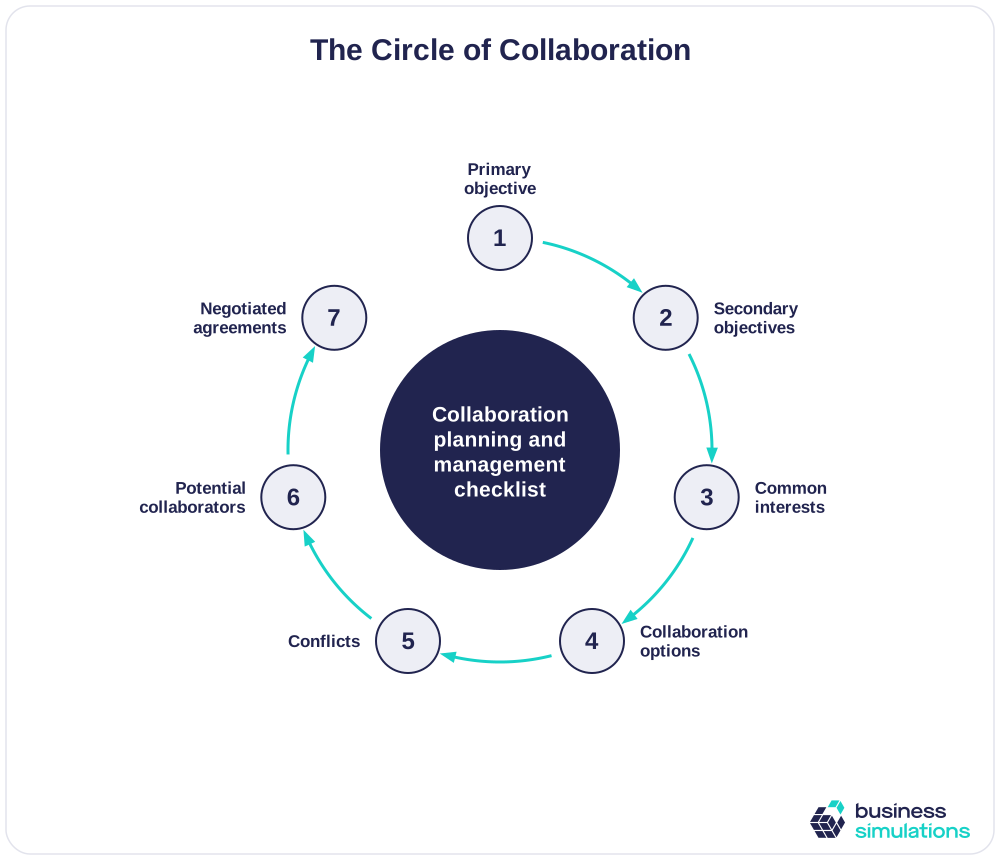
- Primary objective. What is our main objective, the essential one?
- Secondary objectives. What are our other objectives, the desirable ones?
- Common interests. What potential common interests exist between us and the other parties?
- Collaboration options. How might we use those common interests to improve the chances of achieving our primary objective, potentially at the expense of one or more secondary objectives?
- Conflicts. What conflicts exist in these options, whether competitive, organisational, values-based, or legal, and can they be mitigated or are they show-stoppers?
- Potential collaborators. Which parties should we open negotiation with, how many, in what sequence, and with what risks and confidentiality?
- Negotiated collaboration agreements. Is the nature, scope and duration of each agreement crystal clear to everyone involved?
A simple worked example
Take two departments working together to deliver an important project. First, each department needs to be honest about its primary and secondary objectives. This is usually where it starts to go wrong.
The primary objective should be to deliver the project on spec, on time, on quality, and on budget. Everything else is secondary. Typical secondary objectives include:
- Delivering our own part of the project
- Not being the one to blame if the project goes wrong
- Not exceeding our department's share of the budget
- Enhancing our department's reputation with the sponsor, steering committee, and senior management
- Not being seen to be weak or to need outside help
What often happens is that each department quietly inverts the two, putting its secondary objectives ahead of the shared primary one. Because the inversion is unspoken, it is especially damaging.
The way out is to find genuine common ground, for example the fact that both departments need the project to succeed, and then to have an honest conversation about what is driving the inversion and how to stop it. Practical fixes a pair of departments might agree include:
- Agreeing not to blame or brief against each other to the sponsor
- Combining their budgets into a single pot
- Issuing one project update rather than one per department
- Agreeing a clear escalation route for problems
- Keeping a direct line open between the two department heads for when tensions rise
Developing the skill through experience
Because collaboration runs against our competitive instinct, the most reliable way to build it is to practise, and team-based simulations are an effective way to do that in a setting with psychological safety, facilitated by our experts:
- Compete is a business acumen scenario that is mostly competitive, with key moments where a little collaboration is in everyone's interest, as seen in the Danske Bank FinTech case study
- Consortium is a manufacturing scenario where rival companies must share resources and deliver a small pilot together to win a much larger contract, exactly the sub-optimisation problem the Circle of Collaboration is built to solve
If silos and cross-team friction are holding your organisation back, our collaboration challenge sets out how we help leaders and teams develop these skills. If the friction is really about trust, our high-performing teams challenge is the better starting point. Cruise and Dilemma put the same trade-off between function and whole business in front of teams, and if your silos are specific to your own business, we can build a tailor-made simulation around your functions, data, and terminology. We would be glad to talk it through with you.
About the Author

Ken is an expert practitioner, author and speaker on collaboration, high-performing teams and game based learning.
Published Feb 25, 2022