Why customise a business simulation?
By Ken ThompsonLast updated Jul 17, 2026
Off-the-shelf simulations cover a wide range of leadership and management topics, and for many teams they are exactly right. Sometimes, though, a client wants a simulation built around their own organisation. Customising a simulation means tailoring it to a customer's requirements, so it reflects their industry and their company rather than a generic scenario. Here is why a tailored simulation tends to land better, and what it takes to build one.
What you can tailor
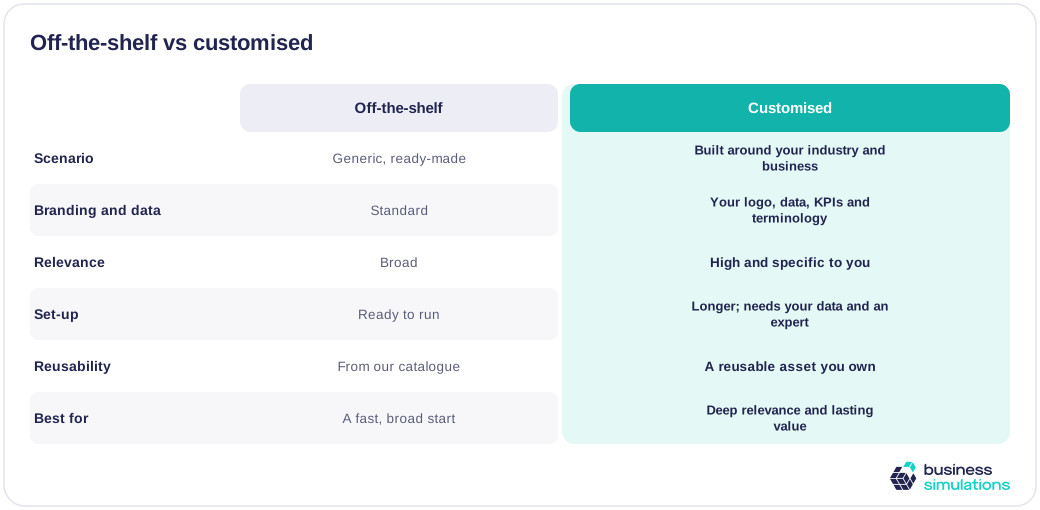
Customisation can reach a long way into a simulation. At the surface, a simulation can carry a company's own branding, financial data, KPI targets, and terminology. Deeper down, the business it models can be reconfigured entirely, from coffee stalls in an artisan market to a legal firm, a fast-food chain, or a broadband provider, along with its market dynamics and the unfolding scenario and news updates that teams respond to.
Why it works better
Sharper relevance and realism
When a simulation uses a company's own products, data, and language, it stops feeling like a generic exercise and starts feeling real. Participants recognise the world they are in, so the rules of the simulation mirror what would actually happen if they made those decisions at work. That makes the concepts easier to grasp and to carry back to the day job.
A unique, reusable asset
A tailored simulation is something an organisation owns and can run again and again, adjusting it as needs change. Built around the company's own context, it becomes a genuine asset rather than a one-off.
More memorable
Company-specific events land harder than generic ones. A supermarket manager will remember how their team handled a story about selling out-of-date stock far more vividly than an unrelated example from another industry, and the supporting documentation reads like the company's own, which adds to the effect.
What it takes
Customisation is not free. A tailored simulation takes longer to design than an off-the-shelf one, because it needs real company data and usually the input of a subject-matter expert from the industry to keep it realistic. That effort is precisely what makes it land, but it is worth going in with eyes open about the time involved.
Is it worth it?
If relevance, realism, and a lasting, reusable asset matter to you, a customised simulation is usually worth the investment. If you need a faster or lighter start, an off-the-shelf simulation, or a foundation simulation customised on top of an existing engine, can get you most of the way for less.
Our tailor-made solutions are built around exactly this, and if you want to see how a custom simulation comes together, we have set out our eight-step design process in detail. To talk through what a tailored simulation could look like for your organisation, get in touch.
About the Author

Ken is an expert practitioner, author and speaker on collaboration, high-performing teams and game based learning.
Published Oct 24, 2014