Business unit leadership: a nine-part best practice model
By Ken ThompsonLast updated Oct 21, 2026
Anyone promoted to lead a business unit or profit centre, or to join its senior team, soon finds there is no training course that covers the pitfalls. This article is for learning and development managers and senior sponsors who need to prepare those leaders before the first quarter, not after it.
The most common induction approach is to watch what others do and pick it up along the way. That is high risk, because it assumes new leaders will get it right first time with no safety net.
There is a better way, and it starts with knowing what good looks like.
Leading a business unit: a best practice model
We have been running business simulations for many years, in which leaders and managers work in teams to run realistic business unit scenarios. From that unique perspective, we have identified nine best practices that set apart the top business unit performers from the rest.
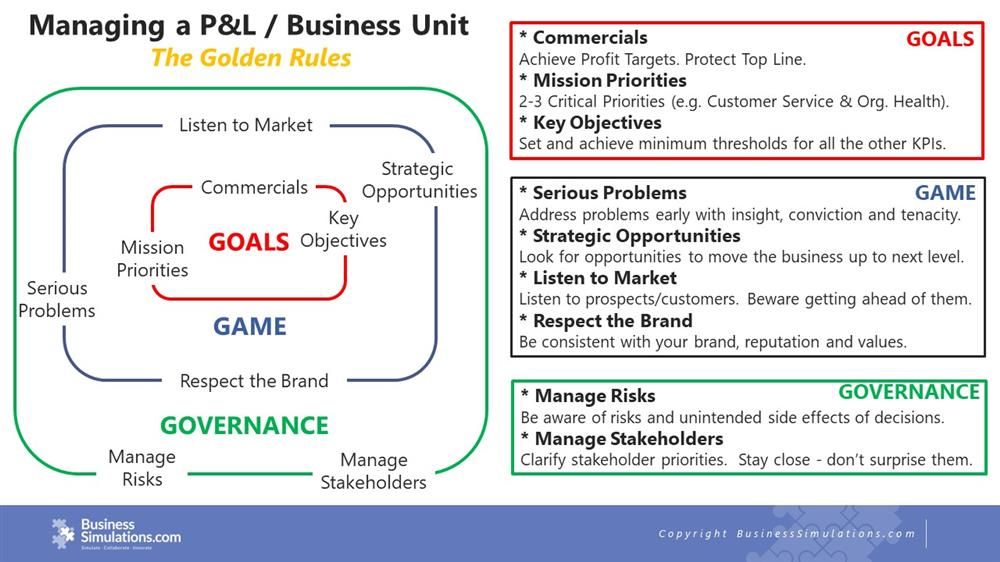
A successful business unit leader will concurrently 'juggle' three major concerns: goals, game, and governance.
A useful metaphor is to think of yourself as the captain of a large passenger jet, the leader of the cockpit team.
1. Goals
Goals are your first key concern, and they involve three core aspects:
- Manage the commercials
- Manage the priority non-commercials
- Manage all the other non-commercials
In the pilot metaphor, this is maintaining airspeed. If the pilots do not manage it properly, nothing else will matter.
2. Game
The game is your second key concern, and it has four important aspects:
- Address serious problems (reactive)
- Exploit strategic opportunities (proactive)
- Listen to the market (reactive)
- Respect the brand (proactive)
In the pilot metaphor, this is navigation. Great airspeed is not enough, because the pilots also need to manage altitude and position at all times.
3. Governance
Governance is your third key concern, and it involves two critical aspects:
- Manage the risks
- Manage the stakeholders
In the pilot metaphor, this is communication with the controllers. Without it, the aircraft may enter controlled airspace without permission or arrive at a busy airport unexpectedly, and either carries a huge risk of collision.
Developing business unit leadership skills
The most effective and safest way to turn these challenging practices into habits is a team-based business simulation, played under the guidance of an expert facilitator who has led business units themselves.
In an immersive simulation, leaders make real-time decisions, see the consequences in their P&L, and debrief what they would do differently. That is where the three concerns stop being a diagram and become a working routine.
We offer two main business unit and P&L simulations:
- Acumen: B2C, a digital services business unit within a highly competitive market
- Acuity: B2B, a product manufacturing business unit within a highly regulated market
Both build the commercial judgement behind our financial acumen challenge, and both support our strategic thinking challenge for leaders who need to make decisions under uncertainty.
What to look for in a business unit simulation
If you are comparing options, a few questions separate a useful learning intervention from a tick-box exercise:
- Do participants run a whole unit, with commercial, operational, and people trade-offs, rather than a single function
- Can they see how their decisions flow through to a P&L and the other key measures
- Is there an expert facilitator who has led a unit and can debrief the choices
- Can the scenario reflect your own industry, products, and terminology
If the last point matters most, our tailor-made simulations are built around your own business, data, and language.
About the Author

Ken is an expert practitioner, author and speaker on collaboration, high-performing teams and game based learning.
Published May 17, 2022