Which business acumen simulation is right for your organisation?
By Ken ThompsonLast updated Jul 17, 2026
Financial acumen is one of the hardest capabilities to build in a classroom and one of the easiest to build through experience. That is the case the financial acumen challenge makes, and it is why we have built a family of business acumen simulations rather than a single course. They share a spine, a realistic P&L, live KPIs, and decisions that carry consequences, but they differ in who they suit, how long they run, and the exact skills they stretch.
This guide compares them so you can match the simulation to your people, your goals, and the time you have. Some organisations run one. Others pair two, for example a short market simulation for emerging talent and a full enterprise simulation for the senior team.
What every business acumen simulation shares
- A realistic profit and loss account and dashboard, so participants read and act on real numbers rather than theory
- Leading and lagging indicators, and the metrics behind them: gross and net margin, contribution, fixed and variable costs, and break-even
- Strategic decisions with visible consequences, reviewed in real time
- Teams running a business together, which surfaces how commercial judgement holds up under pressure
- An immersive, psychologically safe environment, facilitated by our experts, that can run live and in-person, virtually, or hybrid
The five simulations at a glance
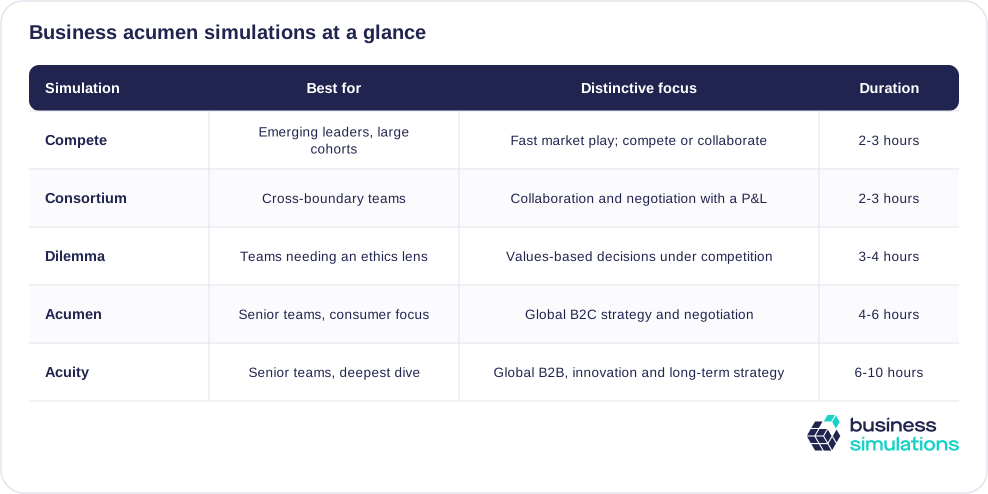
The choice comes down to four things: the seniority of your audience, the time you can give it, the market context (consumer, business-to-business, or a shared market), and the skill you most want to stretch alongside the numbers.
The flagship enterprise simulations
The two deepest simulations put a senior team in charge of a whole global enterprise.
Acumen: leading a consumer business
Acumen puts participants in the executive team of a global business-to-consumer entertainment company across four simulated quarters. It leans into consumer markets: pricing against demand and perceived value, reacting to sudden market shifts, and aligning the team behind a strategy. Its distinctive third skill is negotiation, setting success criteria with the CEO and board and trading off shared objectives with other teams. It runs over four to six hours. Choose it when your priority is commercial and strategic judgement in a consumer-facing business, with a negotiation edge.
Acuity: leading a global business-to-business enterprise
Acuity is the most in-depth simulation in the family, played over six to 10 hours. Participants run a global business-to-business organisation for four years across five regions, managing a portfolio of new and mature products. It is the one to choose when innovation and long-horizon strategy matter: balancing investment across operations, product development, and organisational health, and weighing sales forecasting against production planning. It suits senior teams who need the fullest picture of how strategy, finance, and innovation interact over time.
Faster and more focused
Three shorter simulations widen who you can reach and sharpen a particular edge.
Compete: commercial acumen for emerging leaders
Compete is the fastest, at two to three hours. Teams run rival businesses in a shared market where every decision affects the others. Built for emerging leaders and high-potential talent, it is the most accessible entry into P&L thinking, pricing, and the line between competing and collaborating. Choose it for large cohorts, early-career development, or a punchy module inside a wider programme.
Dilemma: acumen with a values test
Over three to four hours, Dilemma has teams compete for market share while real-world dilemmas around ethics, people, innovation, and technology unfold in the gameplay. It keeps the financial rigour but adds values-based leadership, decisions where the commercially attractive option and the right option pull against each other. In one post-simulation report, over 90% of participants reported a better understanding of aligning financial decisions with business strategy. Choose it when you want commercial judgement and ethical leadership developed together.
Consortium: acumen across organisational boundaries
Consortium is the outlier: financial acumen set inside a collaboration and negotiation challenge. Competing businesses must join forces to deliver a pilot too large for any one of them, protecting their own P&L while reaching agreements that keep the consortium viable. Choose it when your real subject is cross-functional or cross-organisational working, and you want financial fluency built into it rather than taught separately.

How to choose
- Start with your audience. Emerging leaders and high-potential talent point to Compete. A senior or executive team points to Acumen or Acuity
- Then your market context. Consumer-facing decisions suit Acumen; a complex business-to-business portfolio across regions suits Acuity; a shared, competitive market suits Compete or Dilemma
- Then the skill you most want alongside the numbers. Negotiation points to Acumen or Consortium; innovation and long-term strategy to Acuity; ethics and values to Dilemma; cross-boundary collaboration to Consortium
- Then the time you have. Two to three hours suits Compete or Consortium; a half day suits Dilemma or Acumen; a full, in-depth day suits Acuity
- If two needs are equally strong, pairing works well: many organisations combine a short simulation for breadth with a flagship simulation for depth
Find the right fit
If you are weighing these up for a specific group, we can help you match the simulation to your goals and run it live and in-person, virtually, or hybrid, facilitated by our experts. Explore the financial acumen challenge to see how we build commercial capability across an organisation, or get in touch to talk through the right fit for your team.
About the Author

Ken is an expert practitioner, author and speaker on collaboration, high-performing teams and game based learning.
Published Jul 21, 2022