Managing through KPIs: leading and lagging indicators every manager should track
By Ken ThompsonLast updated Jul 30, 2026
For any organisation, business unit, cost centre, department or even a single project, one of the most important management skills is managing through key performance indicators (KPIs).
In short, a strong KPI model balances four kinds of measure: financial and non-financial, and leading and lagging. Leading indicators predict; lagging indicators confirm. Balance them well and the numbers warn you early, while you can still act.
This does not mean you can run a business from behind your desk. You cannot. Managing through KPIs only works when you pair it with managing by walking around (MBWA): staying close to your people, your customers, and the reality behind the numbers. The KPIs tell you where to look. Walking around tells you why.
The four types of indicator
A useful KPI model rests on four types of indicator. Two of them describe what you measure, financial or non-financial, and two describe when the measure tells you something, after the event or in advance. The diagram below shows how they fit together.
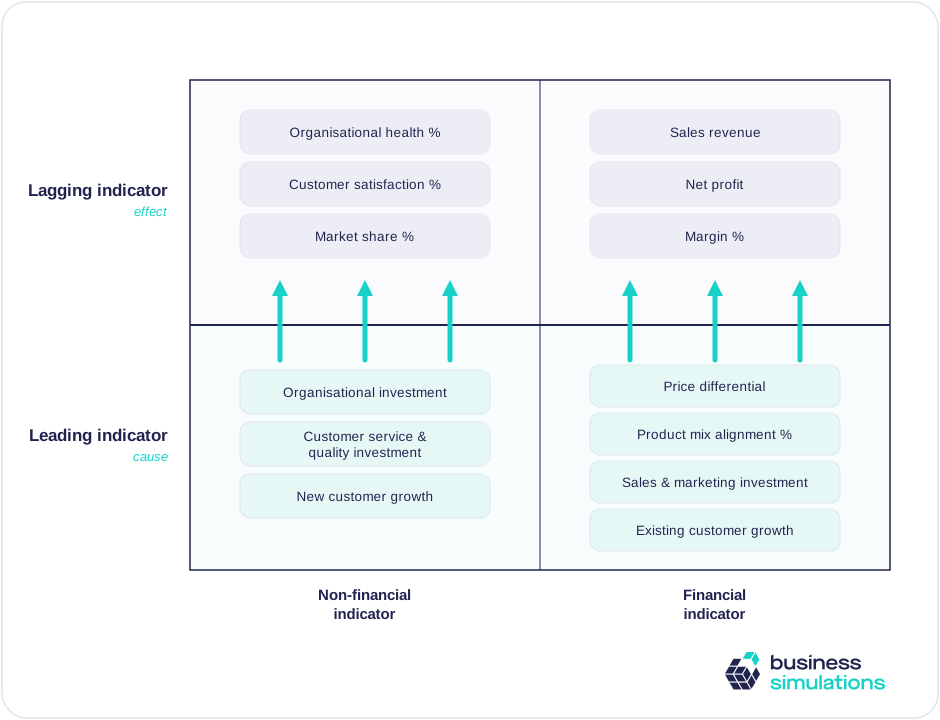
- Financial indicators are monetary measures, and typically appear on profit and loss reports
- Non-financial indicators track key non-monetary outcomes, covering customers, partners, markets and market position, internal processes, quality, organisational health, and people development
- Lagging indicators are the measures, financial and non-financial, by which your success or failure is ultimately judged
- Leading indicators give early warning of whether those lagging indicators will be met
This balance matters more than any single number. Manage on lagging measures alone and you are steering by the rear-view mirror; leading measures point forward, giving you time to act before a result is locked in.
Financial and non-financial, leading and lagging: some examples
Indicators become much easier to choose once you see them mapped out. Here are typical examples in each of the four boxes.
- Financial lagging: revenue, gross margin, and net profit
- Non-financial lagging: customer retention, quality or defect rates, and employee engagement
- Financial leading: sales pipeline value, quotes issued, and the size of the order book
- Non-financial leading: training hours delivered, customer satisfaction scores, and on-time delivery
How to build a balanced KPI model
A good KPI model is well balanced and comprehensive. There are four main steps, and they follow a natural sequence.

Step one: identify your financial lagging indicators
These come from your financial objectives and targets. Focus on the vital few. There should rarely be more than a handful, and for most business units revenue, margin, and a cash or cost measure will carry most of the weight.
Step two: identify your non-financial lagging indicators
These come from your non-financial objectives and targets. Again, concentrate on the ones that matter most, and take care not to miss any. Customer retention, quality, and the engagement of your people all belong here.
Step three: identify your financial leading indicators
For each financial lagging indicator, ask a simple question: what causes it, and how can that cause be measured? A single cause can have several effects, and a single effect several causes, so do not try to map every dependency. Keep it practical: name the two or three leading indicators that act as reliable early warnings for each lagging one, and move on. To take a familiar example, sales and marketing investment and your price differential are good leading indicators for sales revenue.
Step four: identify your non-financial leading indicators
Follow the same approach as for your financial leading indicators. You may need to be more creative here, because the cause is often a behaviour rather than a number. Where no perfect measure exists, use a proxy: it will not be exact, but a proxy indicator is far better than nothing.
A worked example, from marketing spend to revenue
Take revenue as your financial lagging indicator, the number you will ultimately be judged on. Now work backwards. Revenue is driven by the value of the deals you close, which is driven by the size of your sales pipeline, which is driven in turn by the leads your marketing generates. So marketing spend and leads generated become early leading indicators, quotes issued and pipeline value are mid-stage ones, and revenue is the lagging result at the end. Watch the leading measures weekly and you will see a weak quarter coming in time to do something about it. Wait for the revenue figure alone and you are simply recording history.
Common mistakes to avoid
Most weak KPI models fail for the same few reasons.
- Too many indicators: measuring everything clouds what matters, so keep the whole model to a set you can act on, rarely more than 10 across the four boxes
- Only looking backwards: a model built entirely from lagging financial measures tells you the result long after you could have changed it
- Confusing activity with performance: plenty of so-called KPIs are really result indicators or vanity metrics that climb steadily while the business does not actually improve
- Setting and forgetting: KPIs that fitted last year may not fit this year, so review the set regularly and drop the ones you have stopped acting on

Turn your model into a management habit
Build a balanced KPI model, review it on a regular rhythm, and you are well on the way to managing your business unit rather than letting it manage you. Just remember to pair it with managing by walking around, so the numbers stay connected to what is really happening on the ground. The model shows you where to look. Your presence tells you what the numbers cannot.
Practise managing through KPIs in a safe environment
Reading about KPIs is one thing. Building the judgement to choose the right ones, and to read the early warnings correctly, takes practice. An immersive business simulation, facilitated by our experts, lets managers and leaders develop and fine-tune these skills in a psychologically safe environment where mistakes cost nothing and the learning lasts.
Acumen and Acuity both put learners in charge of a business over several years, making the financial and strategic decisions that sharpen commercial judgement, including which indicators to watch and when to act. See how they build financial acumen across your teams on our boost financial acumen page.
About the Author

Ken is an expert practitioner, author and speaker on collaboration, high-performing teams and game based learning.
Published Jun 4, 2022