The three early warning systems every leader needs
By Ken ThompsonLast updated Sep 21, 2026
Most leaders find out that a project is in trouble far too late, and usually from the one source that was always going to tell them last: the formal status report. The fix is not a better report. It is having more than one way to see trouble coming.
There are three kinds of early warning system, and strong leaders run all three at once: formal, social, and signal. It helps to picture them as three concentric rings, with the formal system at the centre and the other two wrapped around it. Many leaders rely only on that inner ring, and it is the one most likely to let them down.
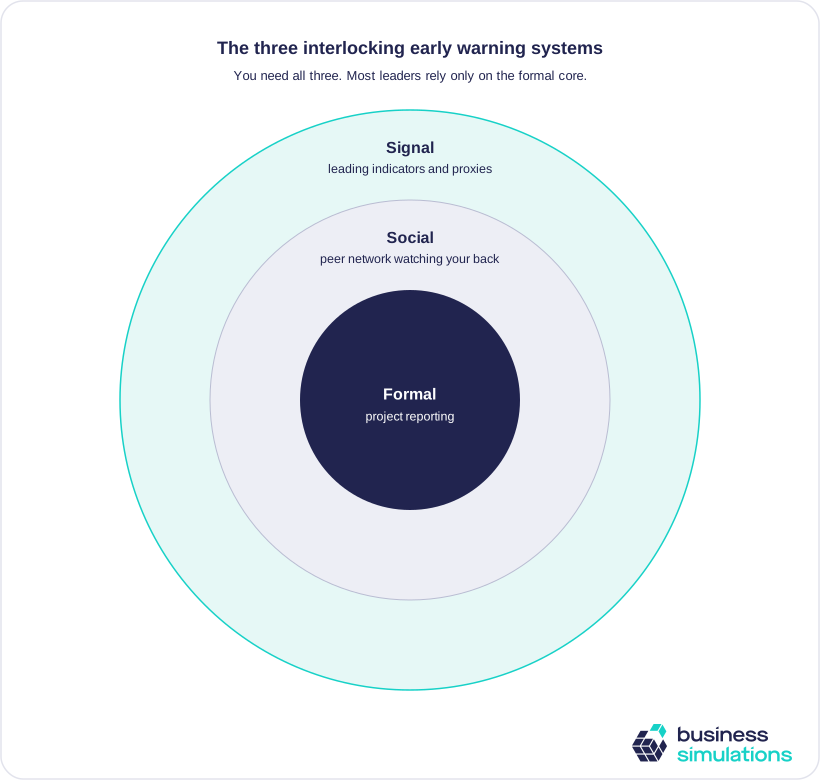
Formal early warning systems
The formal system is the one you already have. You get most of it automatically from good project planning and management disciplines. It has three parts:
- A project plan with clear milestones and review points
- Progress indicators covering resource, cost, and timescale
- Value indicators that track the value the project is actually creating
It is necessary, but it is not enough, for two reasons.
First, it mostly reports lagging indicators rather than leading ones. The distinction comes from the Balanced Scorecard, developed by Robert Kaplan and David Norton. Lagging indicators are good at confirming value, but they tend to arrive too late to act on. By the time the number moves, the problem has already happened. Our guide to leading and lagging indicators goes deeper on this if it helps.
Second, a formal system rarely connects progress to value. Using 75% of the budget does not mean 75% of the value has been delivered. Read on its own, a progress indicator can be quietly reassuring while the venture drifts off course.
Social early warning systems
Your social early warning system is your network of people, usually outside your direct reporting line, who will look out for your incomings. It also has three parts:
- A peer network you can call on
- Enough coverage to reach every part of the venture: stakeholders, customers, internal and external partners, and your own team
- Mutual trust and reciprocity, so information flows both ways
A social system is built one relationship at a time, and it has to be nurtured. In practice it is reciprocal: you watch my back and I will watch yours. Think of it as your grapevine. Its value is that people pass on what they hear the moment they judge it might become your problem, often well before there is any hard evidence. That is exactly why it depends on trust, because much of what travels through it is early, partial, and shared in confidence.
Signal early warning systems
A weakness of formal measurement is that it tends to make important what is measurable, rather than measure what is important. Your signal system is the canary in the mine: the early whiff of a problem before it shows up in any report. Its three parts are:
- A balanced set of measures, not only the ones that are easy to count
- Predictive leading indicators that move before the outcome does
- Qualitative proxies for the intangibles that have no direct measure
It is called a signal system, rather than an information system, on purpose. Much of its value sits in non-traditional, qualitative signs: stakeholders who stop turning up to meetings, or a team that no longer bothers with the post-work drink. There is often no clean metric for things like team morale or stakeholder confidence, which is why the word proxy matters more than indicator here.
To design good signals, work backwards with the Goal-Question-Metric principle: start with the goal of the measurement, then the question you actually need answered, and only then the measure or proxy that gets you closest to it.
Reading trouble early is a leadership skill
Running three interlocking systems, and knowing which one is telling you the truth, is as much art as science. It takes practice, and it is hard to rehearse on a live project where the cost of missing a signal is real.
Build this judgement in a simulation
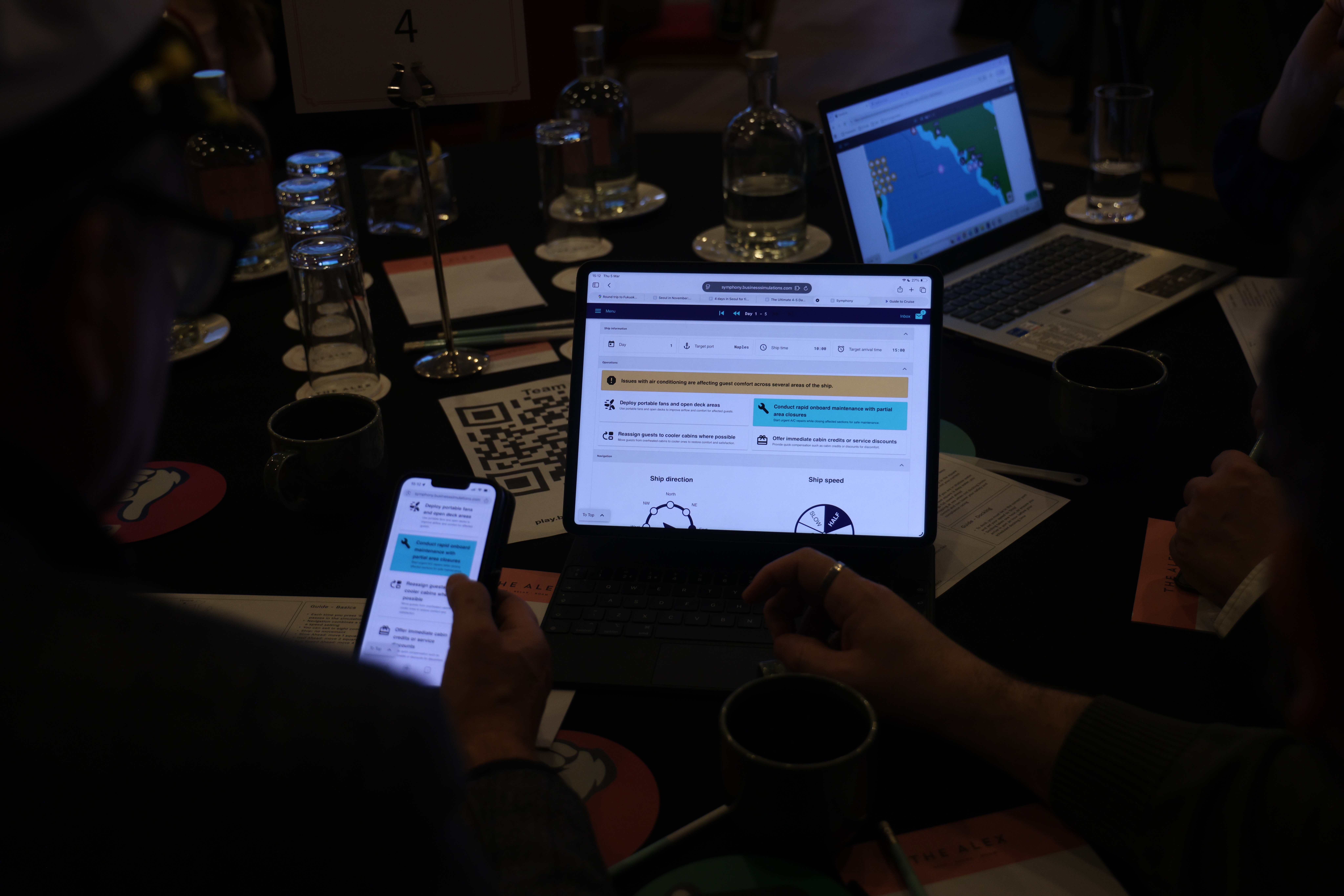
That is what a business simulation is for. Business simulations give leaders a challenging but safe environment to build this judgement. In Acumen, leaders run a global business across several years and learn to read the leading indicators that show where it is heading, not just the lagging ones that confirm where it has been. Acuity does the same across finance, operations, and innovation, where the early signals are easy to miss. Both are immersive, live and in-person, and facilitated by our experts.
If you are developing leaders who make decisions under uncertainty, the strategic thinking challenge is where this capability is built. For the wider toolkit, our strategic thinking models playbook sets out the other models leaders lean on.
Reference
The Balanced Scorecard, and the leading versus lagging indicator distinction, come from Robert Kaplan and David Norton, The Balanced Scorecard (Harvard Business Review Press, 1996).
About the Author

Ken is an expert practitioner, author and speaker on collaboration, high-performing teams and game based learning.
Published Aug 29, 2018